
What Does a Full Paint Correction Actually Involve — And Is It Right for Your Vehicle in Plymouth or Canton?
If you’ve been researching paint correction in the Plymouth and Canton area, you’ve probably noticed that most websites describing the service are frustratingly vague. You’ll find plenty of before-and-after photos and mentions of “swirl marks” being removed — but very few explain what actually happens to your vehicle between drop-off and pickup, why it takes as long as it does, or how a shop decides what level of correction your paint actually needs. That gap in honest information is exactly what this article addresses. Whether you’re driving a daily commuter with years of car-wash haze or a collector car that hasn’t seen a proper polish in a decade, here’s what professional paint correction actually involves — and how to determine whether it’s the right investment for your specific vehicle.
Paint Correction Isn’t a Wash With Extra Steps — Here’s What It Actually Is
Paint correction is a controlled process of removing a microscopic layer of your vehicle’s clear coat in order to eliminate the surface defects living within it. Swirl marks, fine scratches, oxidation, water-spot etching, and buffer trails don’t sit on top of your paint — they’re embedded in it, which is why they survive every car wash, wax, and spray detailer you throw at them. The only way to remove them properly is to level the surrounding clear coat using machine polishers, cutting pads, and a carefully selected compound or polish matched to the severity of those defects.
Done correctly, the result is a depth and clarity in the paint that most people have never seen their vehicle exhibit — even straight from the factory. Done carelessly or by someone without proper training, you risk burn-through, thin spots in your clear coat that can never be recovered without a respray, or a finish that looks temporarily better but deteriorates faster than before.
The Step-by-Step Process: What Happens at the Shop
A legitimate paint correction appointment at a shop like Specialized Automotive in Livonia — convenient to Plymouth, Canton, and the surrounding I-275 corridor — doesn’t start with a polishing machine. It starts with prep.
Step 1: Thorough Decontamination Wash
Before anyone touches your paint with a machine, the vehicle needs to be fully and properly cleaned. This means a thorough hand wash to remove surface dirt and grime, followed by decontamination — typically an iron remover spray (which chemically dissolves embedded ferrous particles from brake dust and road debris) and a clay bar or clay mitt treatment to mechanically pull out embedded contaminants that washing alone won’t reach. In Michigan, where road salt and iron fallout accumulate heavily from late fall through early spring, this step is especially critical. Skipping it and going straight to polishing means you’d be dragging abrasive particles across the paint with your pad — creating more scratches in the process of trying to remove them.
Step 2: Paint Thickness Measurement
This is the step that separates detail shops that know what they’re doing from ones that don’t. Before any machine polishing begins, a professional uses a paint thickness gauge to measure the depth of the clear coat at multiple points across all painted panels. This tells the detailer exactly how much material they have to work with — and sets firm limits on how aggressive a correction can safely be without risking the paint’s structural integrity. Older vehicles, repainted panels, and factory thin spots all get flagged at this stage. If a competitor skips this step, that’s a red flag worth taking seriously.
Step 3: Panel Testing and Product Selection
Not every paint surface responds the same way to the same compound and pad combination. A good detailer will test a small, inconspicuous section of each panel to determine the right combination of machine speed, pad aggressiveness, and product to achieve maximum defect removal without unnecessary clear coat removal. Dark paint, softer European clear coats, and older single-stage finishes all require different approaches. This test section work takes real time — it’s not glamorous, but it’s what determines the quality of everything that follows.
Step 4: Machine Polishing — One or Multiple Stages
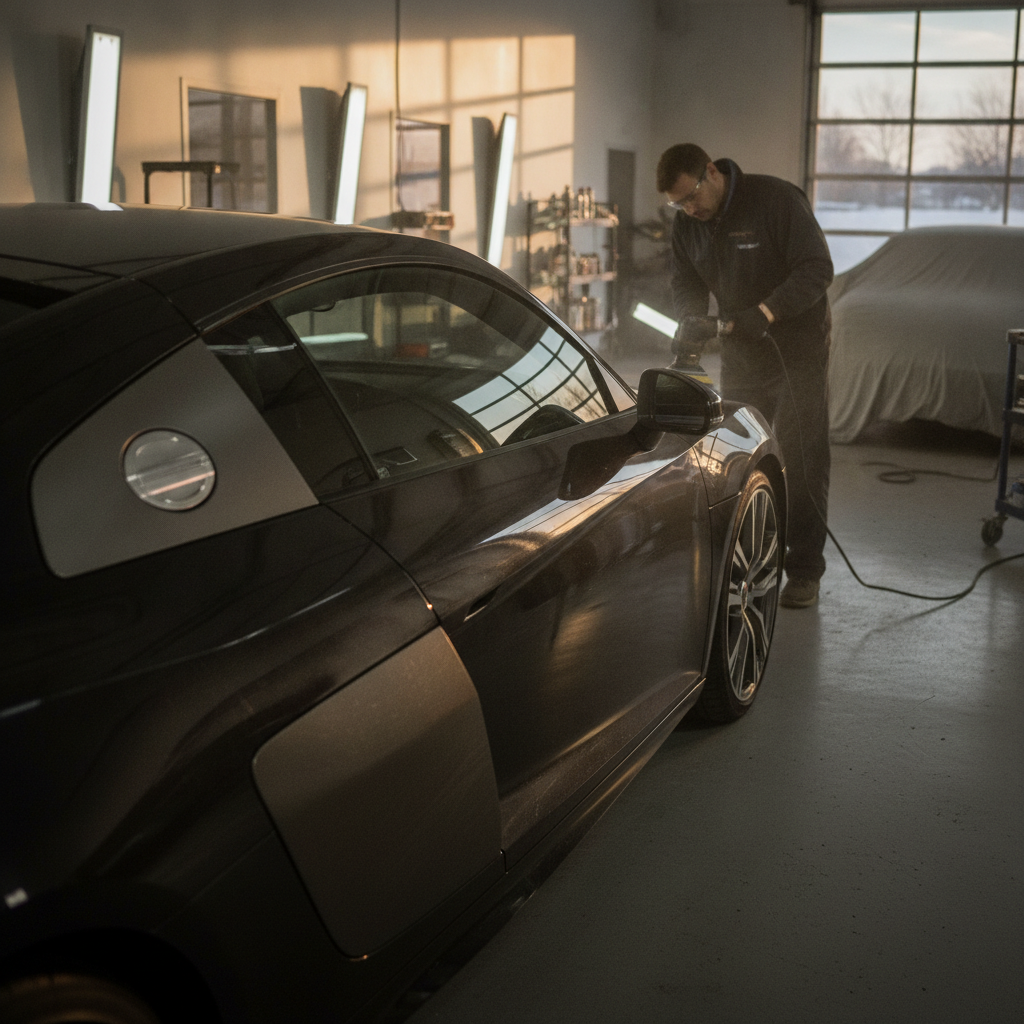
The actual correction work involves running a dual-action or rotary polisher systematically across every painted surface of the vehicle — hood, roof, trunk, doors, bumpers, pillars, mirror caps. Depending on the severity of defects, this may be a single-stage process (one pass with a light polish to address minor swirling) or a multi-stage process that starts with a more aggressive cutting compound to remove deeper scratches and follows up with a finishing polish to refine the surface to a high gloss. Multi-stage corrections take significantly longer — often a full day or more for a single vehicle — but they’re necessary for paint with moderate to heavy defect accumulation.
For vehicles heading into ceramic coating afterward, multi-stage correction is almost always the recommended approach. Coating locks in whatever the paint looks like at the moment of application — including any defects that weren’t addressed.
Step 5: Panel Wipedown and Inspection Under Proper Lighting
Once polishing is complete, each panel gets wiped down with an IPA (isopropyl alcohol) solution to remove any remaining polish oils and reveal the true paint surface underneath. The vehicle is then inspected under high-intensity lighting — typically a combination of direct light and a swirl-finder light — to confirm that defects have been properly addressed and the surface is ready for whatever protection comes next.
Single-Stage vs. Multi-Stage Correction: Which One Does Your Vehicle Need?
The honest answer is: it depends on what condition your paint is actually in, and you won’t know that with certainty until a professional looks at it under proper lighting. But here are some general guidelines:
- Single-stage correction is appropriate for vehicles with relatively light swirl marks and water spots — paint that’s dull or hazy but doesn’t have deep scratches or heavy oxidation. Common on newer vehicles that have been through automatic car washes or washed with dirty mitts.
- Multi-stage correction is appropriate for vehicles with deeper scratches, heavy swirl patterns, oxidation, etching from bird droppings or tree sap, or paint that hasn’t been properly maintained for several years. Also the standard approach for any vehicle receiving a ceramic coating application.
- No correction is appropriate if the clear coat is failing — peeling, flaking, or cracking. Paint correction works within the clear coat; it can’t save clear coat that’s already delaminating. That’s a job for a body shop, not a detailer.
How Long Does It Take — And What Should You Budget?
A single-stage correction on a sedan or compact SUV typically runs 6–10 hours. A multi-stage correction on a larger vehicle, or one with significant defect accumulation, can run 12–20 hours or more across one or two days. This is hands-on, skilled labor — not a service that can be rushed without compromising the result.
For Wayne County vehicle owners researching what this service costs locally, you can get detailed pricing context on our Wayne County service area and pricing page. Generally speaking, expect professional paint correction — done properly with paint thickness measurement, multi-panel test work, and correct product selection — to reflect the skilled labor involved. Quotes that seem dramatically below the market rate typically indicate that corners are being cut somewhere in the process.
The One Part of Paint Correction Most Local Shops Don’t Talk About: What Comes After
Paint correction restores your paint’s surface — but on its own, it doesn’t protect it. Freshly corrected paint is actually more vulnerable to new contamination and UV exposure than paint with a wax or sealant layer on it. That’s why correction is almost always followed immediately by some form of protection. For vehicle owners in Plymouth, Canton, Northville, Westland, Novi, and surrounding Wayne County communities who want to maximize the longevity of the correction work, paint correction paired with a ceramic coating is the most durable path forward — it locks in the corrected finish and protects it from Michigan road salt, UV exposure, and environmental contaminants for years rather than weeks.
If ceramic coating isn’t in the immediate plan, at minimum a paint sealant or carnauba wax should be applied immediately after correction to preserve the results until you’re ready for a more permanent solution.
Frequently Asked Questions: Paint Correction in the Plymouth and Canton Area
Can paint correction remove deep scratches that catch my fingernail?
Probably not completely. Scratches deep enough to catch a fingernail have typically penetrated through the clear coat into the base coat or primer — paint correction works within the clear coat layer. A detailer can minimize the appearance of deeper scratches and improve the surrounding area, but full removal may require touch-up paint or body shop work.
Will paint correction damage my paint if done correctly?
No — when performed by a trained professional who measures paint thickness and selects appropriate products, paint correction removes a controlled and minimal amount of clear coat material. The risk comes from inexperienced operators using overly aggressive compounds, excessive machine speed, or skipping the measurement step entirely.
How do I know if my car actually needs correction or just a thorough detail?
Look at your paint in direct sunlight or under a bright light at a low angle. If you see circular swirl marks, haze, or dull patches that don’t clean up with a wash, those are defects in the clear coat that a detail alone won’t address. A good shop will assess your paint and give you an honest read on whether correction is warranted.
Is paint correction worth it on an older daily driver — not just collector cars?
Absolutely. Paint correction isn’t reserved for six-figure exotics. If you plan to keep your vehicle for several more years, correcting the paint now and protecting it properly afterward will improve its condition and resale value significantly. Specialized Automotive approaches every vehicle — daily driver or rare collectible — with the same standard of care.
How far in advance do I need to book a paint correction appointment?
Because it’s a time-intensive service that occupies the shop for a full day or more per vehicle, availability can fill up — especially heading into spring and fall when demand peaks in the Metro Detroit area. Booking at least one to two weeks ahead is a good rule of thumb, and calling to discuss your vehicle beforehand helps us give you an accurate time and cost estimate before you commit.
Ready to Have Your Paint Assessed by Someone Who Actually Knows What They’re Looking At?
Specialized Automotive is based in Livonia, right off the I-275 / M-14 and I-96 interchange — easy access for vehicle owners coming from Plymouth, Canton, Northville, Westland, and across western Wayne County. Nate founded the business in 2022 after years of working with high-value classic and performance vehicles at a respected Metro Detroit collector-car dealership, and that background shapes how every correction job here gets done: deliberately, precisely, and without shortcuts.
If you’re not sure what your paint actually needs, start with a conversation. Contact Specialized Automotive to schedule a free assessment or ask any questions before booking. Appointments are available seven days a week, and every service is fully insured.