
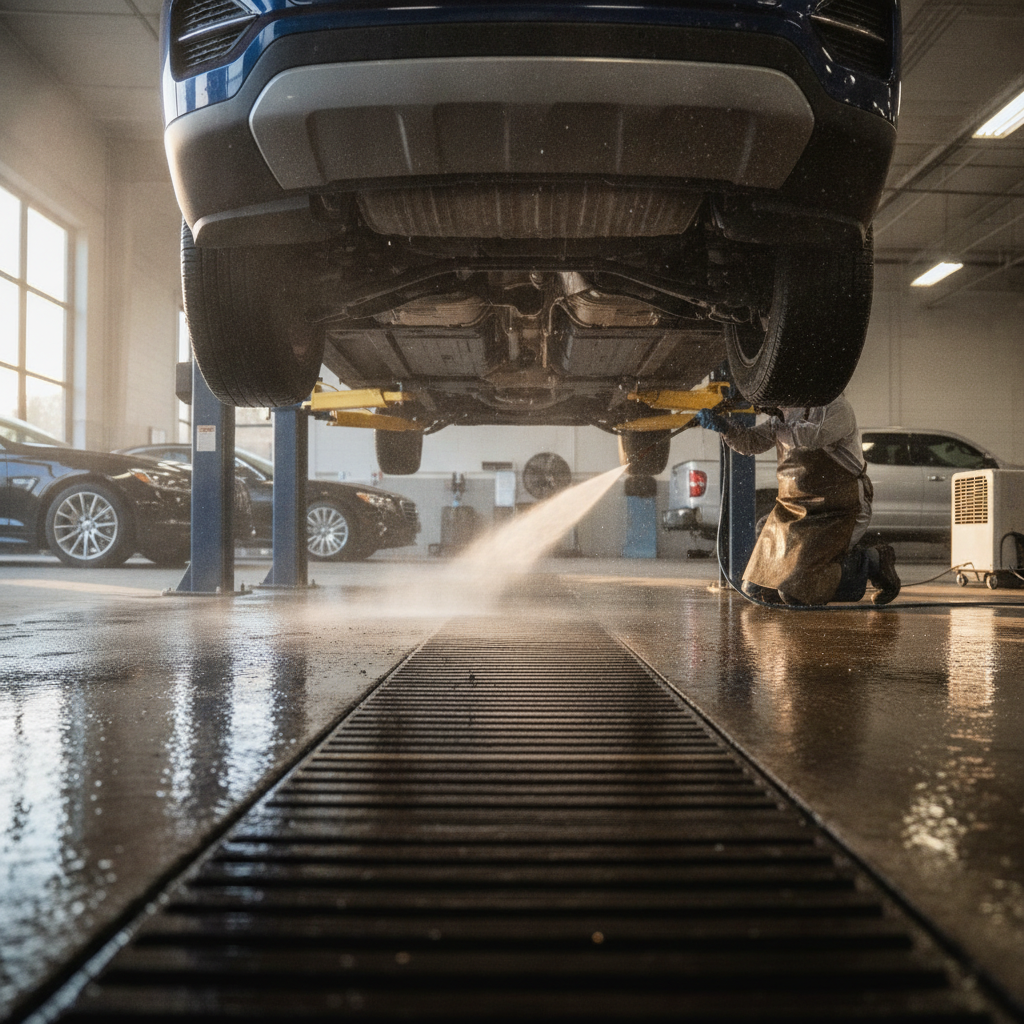
How Do You Remove Road Salt and Winter Grime From a Car’s Undercarriage in Livonia Without Causing More Damage?
The honest answer is that you need dedicated pressure, the right chemistry, and someone who actually gets underneath and looks at what they’re working with — not just a drive-through rinse and a hope for the best. If you’re in Livonia or anywhere along the I-275 corridor, your vehicle’s undercarriage takes a serious hit from November through March. Michigan roads are heavily salted, and that brine doesn’t just wash away on its own. It sits in seams, suspension components, frame rails, and wheel wells, doing quiet, compounding damage long after the snow melts. Proper undercarriage cleaning is one of the most important — and most overlooked — parts of seasonal car care in this region.
Why Michigan Road Salt Is Genuinely Different From Regular Dirt
This isn’t just about appearances. Road salt and the liquid de-icing brine Michigan municipalities apply throughout winter are electrochemically aggressive. When salt bonds with moisture and oxygen on bare or compromised metal, you get accelerating oxidation — rust — that spreads from the inside out. By the time you can see surface rust on a frame rail or subframe, the damage underneath is almost always worse than what’s visible.
The freeze-thaw cycles that define Metro Detroit winters make this worse. Salt-saturated slush works its way into every crevice, freezes, expands, and then thaws again in direct contact with metal. Repeat that process forty or fifty times over a winter season and you understand why vehicles in the Great Lakes region age structurally faster than the same model would in a drier climate. Drivers in Westland, Redford, and Canton who commute daily on heavily treated roads are dealing with this accumulation every single week.
What a Real Undercarriage Cleaning Actually Involves
Here’s where most generic detailing content — and frankly, most local competitors — falls short. They’ll mention undercarriage cleaning as a line item without explaining what distinguishes a thorough job from a pressurized rinse that pushes loose debris around without removing bonded salt deposits.
A proper undercarriage cleaning involves several specific steps:
- Pre-soak with a dedicated degreaser or salt-neutralizing solution. Bonded road grime and brine residue won’t release with water pressure alone. A dwell time with the right chemistry is what actually breaks the bond between salt deposits and the substrate — whether that’s metal, rubber, or underbody coating.
- Targeted high-pressure rinse from multiple angles. Wheel wells, frame rails, suspension arms, axle housings, and the transmission tunnel all need direct attention. A single overhead spray bar doesn’t accomplish this.
- Inspection while it’s clean. This is where a detail shop with real mechanical awareness sets itself apart. Once the undercarriage is clean, it’s worth looking at what’s actually there — early rust spots, cracked undercoating, compromised seals — because that’s information you can act on before it becomes a costly repair.
- Optional protectant application. Some owners, particularly those with older vehicles or daily drivers with higher mileage, benefit from a fresh application of underbody protectant after cleaning to slow future corrosion.
The Problem With Drive-Through Car Washes for Salt Removal
The automated car washes along major corridors in Dearborn and Canton that advertise an “undercarriage rinse” as a $3 add-on are not doing what you need. The undercarriage spray systems in most tunnel washes are designed to knock loose surface debris — they’re not calibrated for dwell time, targeted angle coverage, or the kind of pressure that actually addresses packed salt in suspension components. You’re paying for the illusion of protection, not the real thing.
This is especially true after a vehicle has gone an entire winter without a proper cleaning. By February or March, you don’t just have surface salt — you have layers of accumulated brine, mud, and compacted grime that have been cycling through freeze-thaw repeatedly. That requires real work to address. Professional auto detailing that includes a genuine undercarriage service is a different category from automated washing, and it’s worth understanding that difference before assuming one substitutes for the other.
Spring Is the Critical Window — and Most Owners Miss It
The single most impactful time to address undercarriage salt accumulation is early spring, immediately after the last significant road treatment of the season. This is the window where removing what’s accumulated prevents it from continuing to react with metal through the warmer, wetter months ahead. Corrosion doesn’t pause because it’s July — it actually accelerates in heat and humidity if salt residue is still present.
Many Plymouth and Canton owners bring their vehicles in for spring detailing focused entirely on the paint and interior — the visible stuff. The undercarriage gets deferred until it’s an obvious problem. By then, you’re dealing with rust remediation rather than rust prevention, and those are very different conversations.
What About Classic and Collector Cars?
If you’re storing a collector car through the winter — which is the right call on salted Michigan roads — the undercarriage cleaning matters both going into storage and coming out. Before storage, you want any accumulated road contamination removed so it isn’t sitting against metal through months of dormancy. Coming out of storage in spring, a full detail that includes the undercarriage confirms the vehicle is clean and gives you a baseline inspection before the driving season starts.
At Specialized Automotive, classic and collector car storage is paired with detailing specifically because these two services reinforce each other. Nate built this approach from his years prepping high-value collector vehicles at a Metro Detroit dealership — an environment where the mechanical and cosmetic condition of a vehicle were always evaluated together, not in isolation.
What to Ask a Detailer Before Booking an Undercarriage Service
Not every shop that lists undercarriage cleaning delivers the same result. Before you book, it’s worth asking a few direct questions:
- Do you pre-treat with a degreaser or salt-neutralizing solution, or is it just a pressure rinse?
- Do you hand-address wheel wells and suspension areas, or is it handled by an automated system?
- Will someone inspect the undercarriage condition and flag anything worth knowing about?
- Is this included in a full detail, or is it a dedicated stand-alone service?
A shop that can answer these questions clearly knows what they’re doing. One that defaults to vague assurances about their equipment probably doesn’t prioritize this service the way you need them to.
Frequently Asked Questions
How often should I have my undercarriage cleaned if I drive year-round in Michigan?
At minimum, once in early spring after the road salt season ends and once before winter storage or before the first significant snowfall. If you’re driving heavily through winter in a daily driver, a mid-winter undercarriage rinse from a professional — not an automated wash — is worth adding in January or February.
Can undercarriage cleaning prevent rust on an older vehicle, or is it too late?
It depends on the current condition. Removing salt buildup stops active corrosion from progressing further, even on older vehicles with some existing surface rust. Combined with a fresh underbody protectant application, it can meaningfully slow deterioration even when you’re not starting with clean metal. It’s never too late to stop making things worse.
Is undercarriage cleaning included in a standard full detail at Specialized Automotive?
Undercarriage and wheel well cleaning is part of our full exterior detail service. We don’t treat it as an afterthought. If you have specific concerns about salt accumulation or want a more focused inspection, mention that when you book and we’ll structure the service accordingly.
Do you service trucks and SUVs the same way as passenger cars?
Yes. Trucks and body-on-frame SUVs actually have more surface area to address underneath — frame rails, transfer cases, differential housings — and they tend to accumulate more because they ride through conditions that lower-profile passenger cars avoid. The same precision standard applies regardless of vehicle type.
My car lives in a garage in Livonia — does it still need undercarriage cleaning?
If it drives on Michigan roads at any point between November and April, yes. Garage storage prevents weather damage to the exterior but doesn’t protect you from what accumulates underneath during the drive home every day. The salt comes with the vehicle and keeps reacting in your garage.
Get the Salt Out Before It Gets Further
The undercarriage of your vehicle is where Michigan winters do their most serious work — and it’s the part most detailers gloss over. At Specialized Automotive in Livonia, we approach every vehicle the same way whether it’s a daily driver from Redford or a collector car coming out of winter storage: the parts you can’t see get the same attention as the parts you can.
If your vehicle has been through another Michigan winter and hasn’t had a real undercarriage cleaning, now is the time. Contact us to schedule a service or ask about our spring detailing and storage packages — we’re available seven days a week and located just off the I-275 and I-96 interchange for easy access from anywhere in Wayne or Oakland County.