
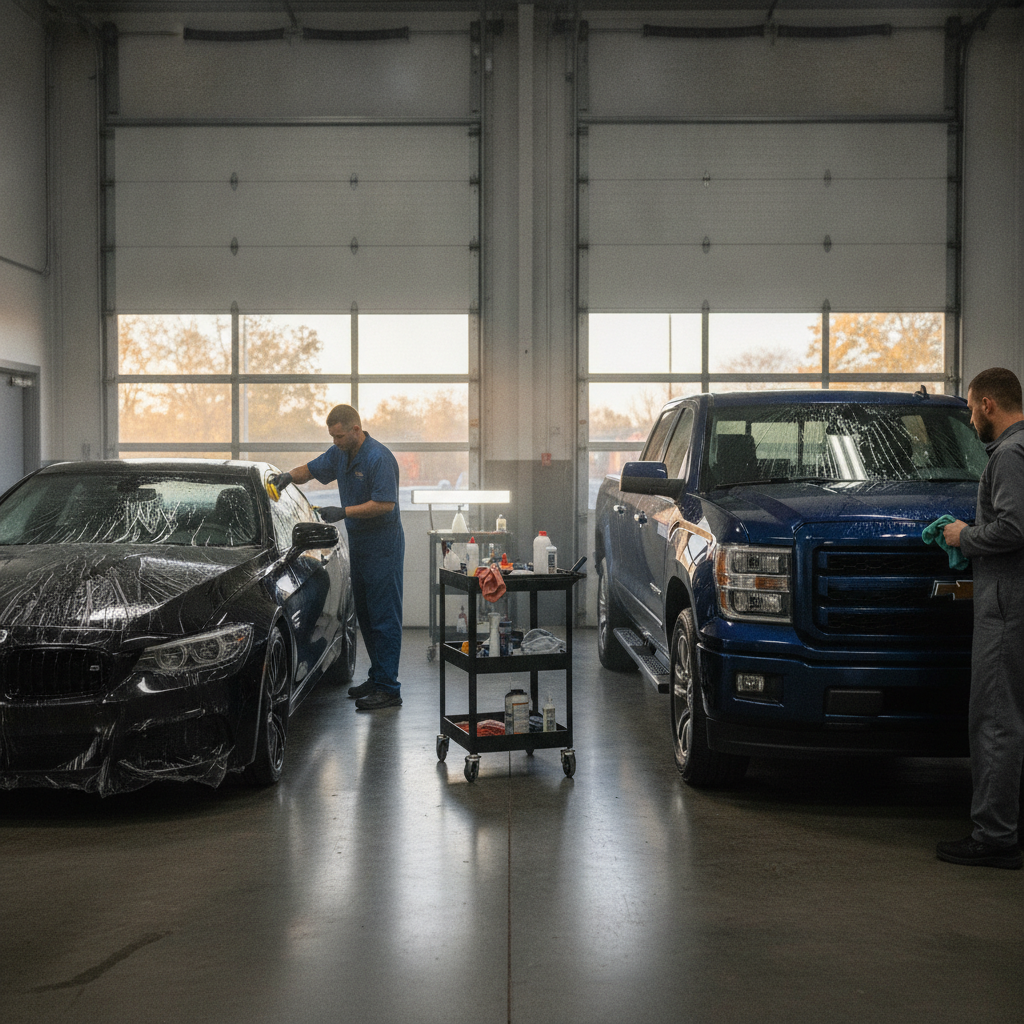
Does Paint Protection Film or Ceramic Coating Make More Sense for Your Vehicle in Novi or Canton?
If you’re trying to protect your vehicle’s paint for the long haul in Novi, Canton, or anywhere across Metro Detroit, you’ve almost certainly run into both options: paint protection film (PPF) and ceramic coating. They’re both legitimate, long-term investments — but they don’t do the same thing, and choosing the wrong one for your situation means spending real money on protection that doesn’t fully address what your vehicle actually needs. The short answer is that PPF guards against physical damage while ceramic coating guards against chemical and environmental contamination. Most serious vehicle owners eventually consider combining both. But the right starting point depends on what you drive, how you drive it, and what you’re trying to protect it from.
What Paint Protection Film Actually Does — And What It Doesn’t
Paint protection film is a thick, optically clear thermoplastic urethane film that bonds to your vehicle’s paint surface. Its core job is absorbing physical impacts before they reach your paint — rock chips on the highway, door dings in a parking structure, road debris, and the kind of low-speed abrasion that Michigan’s deteriorating pavement and gravel-covered construction zones create constantly. Quality PPF also has self-healing properties: minor surface scratches in the film itself can disappear with heat exposure, keeping the surface looking clean without intervention.
What PPF is not particularly designed to do is repel water, resist brake dust, block UV degradation, or make your paint easier to clean over time. A bare PPF installation without a coating over it can actually be harder to maintain because the film surface can attract contamination. That’s one reason many detailers — including here at Specialized Automotive — will recommend a ceramic coating applied over PPF when it makes sense for the vehicle.
PPF is also substantially more expensive and labor-intensive to install properly. A full-vehicle PPF wrap requires precision cutting, experienced hands, and time. Partial coverage — protecting just the front bumper, hood leading edge, fenders, and mirrors where most highway impact damage occurs — is a more accessible approach for daily drivers and is often the smarter call for a practical vehicle that isn’t a collectible.
What Ceramic Coating Does That PPF Cannot
A professional ceramic coating bonds chemically to your vehicle’s clear coat and creates a hardened, hydrophobic surface layer that sheds water, resists UV oxidation, repels road salt, and makes the paint dramatically easier to maintain between washes. For drivers in Wayne County and across Oakland County who deal with months of road salt exposure every winter, that chemical resistance matters more than people often realize. Salt doesn’t just sit on the surface — it etches into unprotected clear coat over time.
Where ceramic coating falls short is physical protection. A flying rock at highway speed on I-275 will chip a ceramic-coated paint surface just as effectively as it would an uncoated one. The coating adds hardness and some minor scratch resistance, but it is not a physical barrier the way PPF is. Anyone who tells you otherwise is overselling it.
Ceramic coating is the more broadly applicable choice for the largest number of vehicles: it’s more affordable, it applies to the entire vehicle uniformly, and it provides meaningful long-term protection against the specific environmental threats that Michigan driving creates — UV, road salt, hard water mineral deposits, and airborne industrial fallout. Pricing for professional-grade ceramic coating typically runs from roughly $600 on the lower end for single-layer applications on smaller vehicles up to $1,500 or more for larger vehicles or multi-layer premium packages with extended protection warranties.
The Honest Comparison: Which One Is Right for Your Vehicle?
Here’s how most experienced detailers actually think through this decision with their clients:
- Daily driver on Michigan highways: Ceramic coating is usually the smart primary investment. If you want to add PPF to the front end where chip damage concentrates, that’s a meaningful upgrade — but full-vehicle PPF on a practical daily driver is often hard to justify on cost alone.
- New or nearly-new vehicle you plan to keep long-term: The best time to apply both PPF and ceramic coating is as early as possible — ideally before the first highway drive. The paint is in factory condition, preparation time is minimal, and you’re protecting the investment from day one.
- Classic, exotic, or collector vehicle: This is where the calculus shifts significantly. A vehicle with irreplaceable original paint, or a freshly restored finish that represents thousands of dollars in paint correction work, deserves the most comprehensive protection available. PPF on vulnerable panels with ceramic coating over it is often the right answer for a collector car that sees road time.
- Leased vehicle: PPF makes a compelling case here specifically because it can be removed without damaging the paint surface underneath — an important consideration when turn-in time arrives. A full ceramic coating on a leased vehicle makes less financial sense unless you’re planning to purchase at lease end.
Why This Comparison Is Missing From Most Local Competitor Content
Most detailing shops in the Metro Detroit area will tell you they offer ceramic coating and may mention PPF in passing — but very few walk you through an honest side-by-side comparison that helps you make the right call for your specific vehicle. The tendency is to recommend whatever product the shop is most invested in selling, or to default to the higher-ticket option without explaining why it fits your situation. That’s not how we approach it at Specialized Automotive.
Nate built this business on the understanding that high-value vehicles — whether that’s a six-figure exotic or a daily driver that represents a major financial commitment to its owner — deserve honest guidance, not upsells. If PPF is overkill for your situation, we’ll tell you. If ceramic coating alone isn’t going to protect what you’re worried about protecting, we’ll tell you that too. That same approach is why owners from Northville to Farmington Hills to Plymouth trust us with vehicles they care about.
One thing worth knowing before any protection is applied: if your paint has existing swirl marks, oxidation, scratches, or surface defects, those need to be corrected first. PPF and ceramic coating will lock in whatever condition the paint is in at the time of application. A thorough paint correction stage before protection isn’t optional — it’s what separates a professional result from one that looks adequate for about six months and then starts to disappoint.
Can You Apply Ceramic Coating Over PPF?
Yes — and it’s a combination that genuinely makes sense for the right vehicle. PPF handles the physical impact layer; ceramic coating applied over the film’s surface improves hydrophobic performance, makes the film easier to maintain, and extends the visual quality of the installation. It’s a layered approach that addresses both major threat categories: physical damage and chemical/environmental degradation.
If you’re considering this combination for a collector vehicle or a high-value daily driver near Livonia or Canton, it’s worth having a direct conversation about which surfaces warrant full PPF coverage and which can be handled with ceramic coating alone. That kind of zone-by-zone analysis is exactly how a specialist should approach it — not a one-size solution pushed on every vehicle that comes through the door.
Frequently Asked Questions
Does paint protection film require maintenance?
Yes. PPF needs to be hand-washed carefully, kept free of prolonged contamination, and inspected periodically. Applying a ceramic coating over the film simplifies maintenance significantly and keeps the film looking its best over time.
How long does PPF typically last compared to ceramic coating?
Quality PPF installations from reputable manufacturers are typically warranted for 10 years. Professional ceramic coatings vary — entry-level single-layer products may last two to five years with proper maintenance, while premium multi-layer coatings can exceed seven to ten years depending on the product and how the vehicle is cared for.
Is PPF worth it on a vehicle I drive through Michigan winters?
It depends on what you’re protecting and where the vehicle sits when it’s not being driven. If you’re driving it on salted roads regularly, PPF on the front end combined with ceramic coating over the whole vehicle is a strong combination. If your collector vehicle goes into climate-controlled storage for the winter, the calculus shifts — you’re protecting against summer road use, not salt season.
Can either product be applied to a vehicle that already has paint damage?
No — not responsibly. Both PPF and ceramic coating should be applied over paint that has been properly corrected and decontaminated. Skipping that step means protecting defects in place, which is both a visual and a long-term quality issue.
Do you offer PPF installation at Specialized Automotive?
Reach out directly and we’ll talk through what makes sense for your specific vehicle. We’re honest about what we offer and what the right solution is — and we’re available seven days a week for consultations and appointments.
If you’re trying to make the right call on paint protection for a vehicle you care about — whether that’s a weekend collector car, a new daily driver, or a truck you want to keep looking clean for years — the best next step is a straightforward conversation. Contact Specialized Automotive through our contact page and we’ll help you figure out what actually makes sense for your vehicle, your budget, and how you use it.