
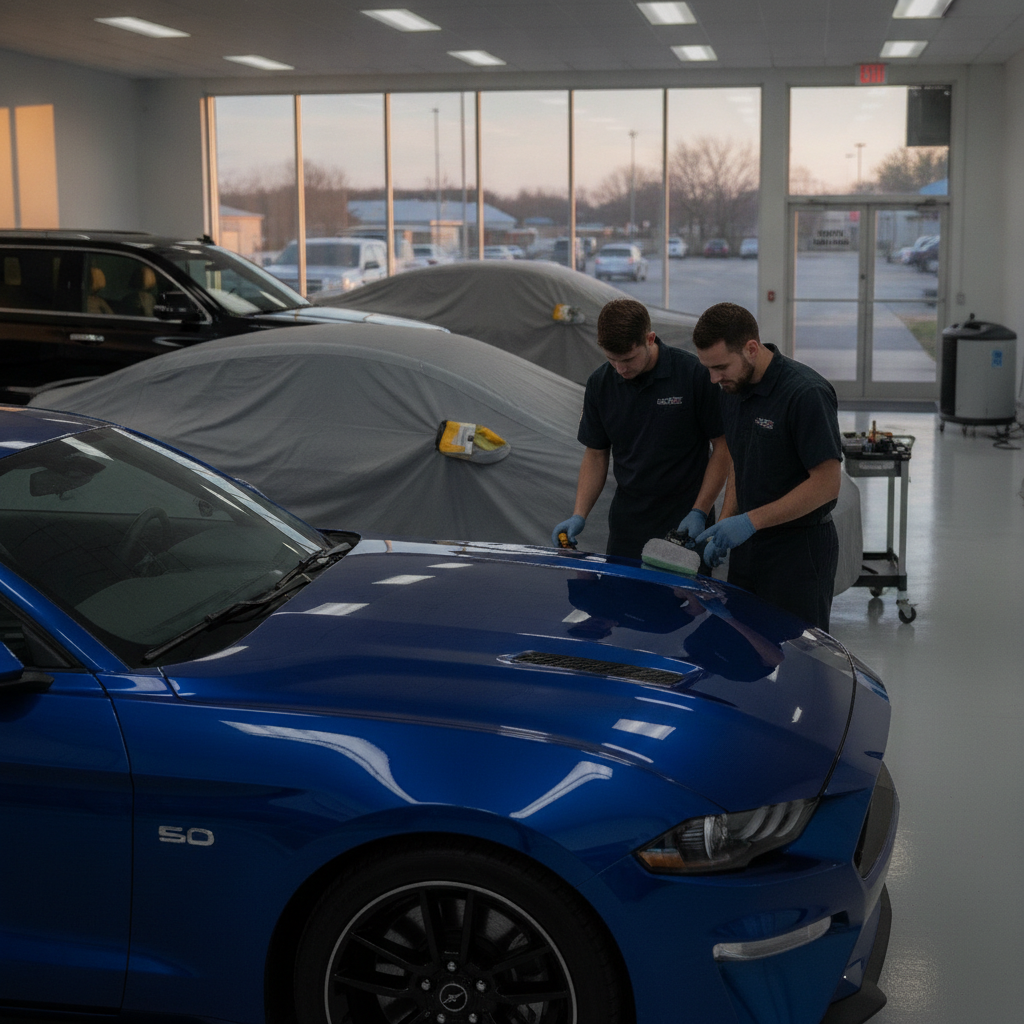
How Do You Know If a Paint Correction Shop in Dearborn or Taylor Is Actually Qualified — Or Just Winging It?
Here’s the honest answer: in most cases, you can’t tell from a website alone. Any shop with a polisher and a Google Business profile can advertise paint correction in the Dearborn and Taylor area — but machine polishing in untrained hands doesn’t restore paint. It removes it. And since your clear coat is only a few microns thick, a shop that doesn’t know what they’re doing can create damage that’s either extremely expensive to fix or, in the worst cases, irreversible. This guide walks you through exactly how to separate a genuinely qualified paint correction specialist from someone who learned the term on YouTube and bought a random orbital off Amazon.
Why Paint Correction Is One of the Easiest Services to Fake
Unlike a brake job or an engine repair, paint correction produces results that look impressive immediately — even when the technique is wrong. A shop can run a single-stage machine polish over heavily swirled paint and show you a before-and-after photo that looks dramatic. What they may not tell you is that they used excessive machine pressure, skipped paint thickness measurement, left holograms in the finish, or burned through the clear coat on panel edges. You might not notice any of that until six months later — if you notice it at all.
This matters especially in Wayne County, where Michigan winters do real work on paint. Road salt, grit, and the freeze-thaw cycle leave vehicles in Dearborn, Taylor, Westland, and Garden City with oxidation, water spotting, and swirl patterns that genuinely benefit from professional correction. But the demand for that service has also created an opening for under-qualified shops to position themselves as specialists without the background to back it up.
The Questions to Ask Before You Book Anything
Before you schedule paint correction anywhere — including here — ask these questions directly. A shop that takes paint seriously will answer them without hesitation.
Do you measure paint thickness before you start?
This is non-negotiable. A paint thickness gauge tells the technician exactly how much clear coat is present on each panel before they ever touch a machine to it. Without that baseline measurement, there’s no way to know how aggressively to correct or whether correction is even safe on a given area. If a shop tells you they don’t measure, or that they “can just tell by looking,” that’s a red flag serious enough to end the conversation.
What compounds and polishes do you use, and how do you match them to the paint?
Professional paint correction isn’t a one-product process. A qualified technician stages their approach — starting with a heavier cut compound to remove deeper scratches and swirls, stepping down to a finer polish to remove the marring left by the compound, and finishing with a refining polish or finishing pad to restore true clarity. The specific products and pad combinations vary by paint hardness, which itself varies by manufacturer. A shop that uses the same product on everything, or that can’t explain their process in plain terms, probably isn’t doing multi-stage correction — they’re doing a single aggressive pass and calling it done.
Can you show me work you’ve done on paint similar to mine?
Portfolio photos are useful context, but specificity matters. A shop that has corrected German soft clears, Japanese hard clears, and classic single-stage lacquers has a fundamentally different skill set than one that primarily works on newer domestic vehicles. Ask for examples that are relevant to your vehicle. If they can’t produce them, that’s worth noting.
What a Real Two-Stage or Three-Stage Correction Actually Involves
One of the most common shortcuts in the detailing industry — one that competitors in this area rarely explain in detail — is selling a “one-stage polish” as paint correction. A single-stage polish can improve the appearance of lightly swirled paint. But it’s not the same as multi-stage correction, and it won’t produce the same depth of clarity or durability.
True two-stage correction involves a cutting stage to remove oxidation, scratches, and swirl marks, followed by a polishing stage to refine and clarify the surface. Three-stage correction adds a finishing stage for maximum gloss and clarity — typically reserved for high-end paint on collector or exotic vehicles where the standard is absolute. At Specialized Automotive in Livonia, every paint correction service is quoted based on the actual condition of your paint — not a flat-rate package that applies the same process to every vehicle regardless of what the paint actually needs.
Why Michigan Paint Specifically Demands More Precision
Vehicles in southeast Michigan take a beating that drivers in milder climates don’t experience. If you’re in Taylor or Dearborn, you’re running on salted roads from November through March, dealing with temperature swings that can span 40 degrees in a single day, and then hitting intense summer UV exposure that accelerates oxidation on any paint that isn’t properly protected. That combination accelerates the kind of defects — water spots, salt etching, fine marring from inadequate winter washing — that make paint correction both more necessary and more technically demanding than it might be for a vehicle kept in a warmer, drier climate.
A technician who hasn’t worked extensively with Michigan vehicles may underestimate how deeply embedded some of those contaminants are, or skip the decontamination step — clay bar treatment and chemical decon — that has to happen before machine polishing begins. Skipping decon means you’re polishing over embedded iron particles and road fallout, which creates new marring while you’re trying to remove old marring.
The Gap Most Local Competitors Leave Open: Process Transparency
If you spend time reviewing what competing shops in the Metro Detroit area publish online, you’ll notice a consistent pattern: they list paint correction as a service, sometimes with a price range, but almost none of them walk you through what the process actually involves step by step. That information gap isn’t an accident — it’s easier to sell a service people don’t fully understand. But it also means customers can’t effectively evaluate whether they’re getting what they paid for.
Here’s what a legitimate paint correction process — from intake to final inspection — should include:
- Pre-wash and decontamination — foam wash, iron decon spray, and clay bar treatment to remove bonded surface contaminants before any machine work begins
- Paint thickness measurement on every major panel, documented before and referenced throughout correction
- Test panel — running a small area of correction first to confirm product and pad combination before committing to the full vehicle
- Multi-stage machine correction matched to paint hardness and defect severity
- High-intensity inspection lighting at every stage to verify defect removal without introducing new marring
- Panel wipe-down with an IPA solution to remove polish oils so the true corrected finish can be evaluated — and so any subsequent coating bonds correctly
- Final inspection under multiple light sources before the vehicle is released
If a shop can’t walk you through each of these steps before you book, ask why. Their answer will tell you a lot.
What Comes After Correction — And Why It Matters
Paint correction restores your paint; it doesn’t protect it. Once the surface has been corrected and refined to its best possible state, that’s the ideal time to apply protection — either a high-quality paint sealant or, for longer-term defense, a professional ceramic coating. A ceramic coating applied over properly corrected paint bonds to a clean, flat surface and delivers years of protection against UV, road salt, and surface contamination. Applied over uncorrected or contaminated paint, the same coating locks those defects in permanently.
That’s why at Specialized Automotive, paint correction and ceramic coating are treated as a connected process — not two separate upsells.
Frequently Asked Questions
How much does professional paint correction cost in the Dearborn and Taylor area?
Cost depends on vehicle size, paint condition, and how many stages of correction are required. Light single-stage polishing and full three-stage correction on a heavily oxidized vehicle are very different services at very different price points. Any shop that gives you a firm quote without seeing the vehicle in person — or without measuring paint thickness — is guessing. A proper consultation should come first.
Can paint correction fix deep scratches that go through the clear coat?
No. Machine polishing works within the clear coat layer. It removes surface-level defects — swirl marks, fine scratches, water spots, light oxidation, and haze. Scratches that have cut through the clear coat and into the base coat or primer require touch-up or respray, not polishing. A qualified technician will tell you this upfront rather than run a machine over it and hope you don’t notice the difference.
Is paint correction safe on older or classic vehicles?
It can be, but it requires more caution. Older vehicles — particularly classics with original single-stage paint — often have significantly less paint thickness than modern vehicles with factory clear coat. Correction on these vehicles demands more conservative product selection, lighter machine pressure, and more frequent thickness checks. Not every shop has the experience to work on older paint safely. Ask specifically about their experience with the type of vehicle you own.
How long does paint correction take?
A legitimate multi-stage correction on a full-size vehicle typically takes one to two full days depending on paint condition and vehicle size. If a shop is quoting you a few hours for a complete correction on a heavily swirled vehicle, they’re either doing a single light polish or they’re rushing. Neither produces the result a true correction should.
Do I need paint correction if my car is going into storage?
If your vehicle is going into long-term storage — particularly climate-controlled winter storage for a collector or classic car — correcting and sealing the paint beforehand is one of the best things you can do. Stored vehicles that go in with surface contamination, water spots, or light oxidation can see those issues worsen over months in storage. Coming out of storage with clean, corrected, protected paint means your vehicle is ready to enjoy the moment the season changes, not in need of remediation work.
Ready to Have Your Paint Evaluated by Someone Who Actually Knows What They’re Looking At?
Specialized Automotive is based in Livonia, just off the I-275 / M-14 interchange, and serves vehicle owners throughout Wayne County — including Dearborn, Taylor, Westland, Garden City, and Wayne. Founder Nate built his expertise prepping and detailing high-value collector and performance vehicles at a respected Metro Detroit dealership before starting Specialized Automotive in 2022. Every vehicle that comes in — daily driver, classic, or exotic — gets the same standard of care and the same honest assessment.
If you want to know exactly what your paint needs and what it would take to get it right, reach out to schedule a consultation. We’ll look at the paint, measure it, and tell you straight what correction can realistically achieve — before you commit to anything.