
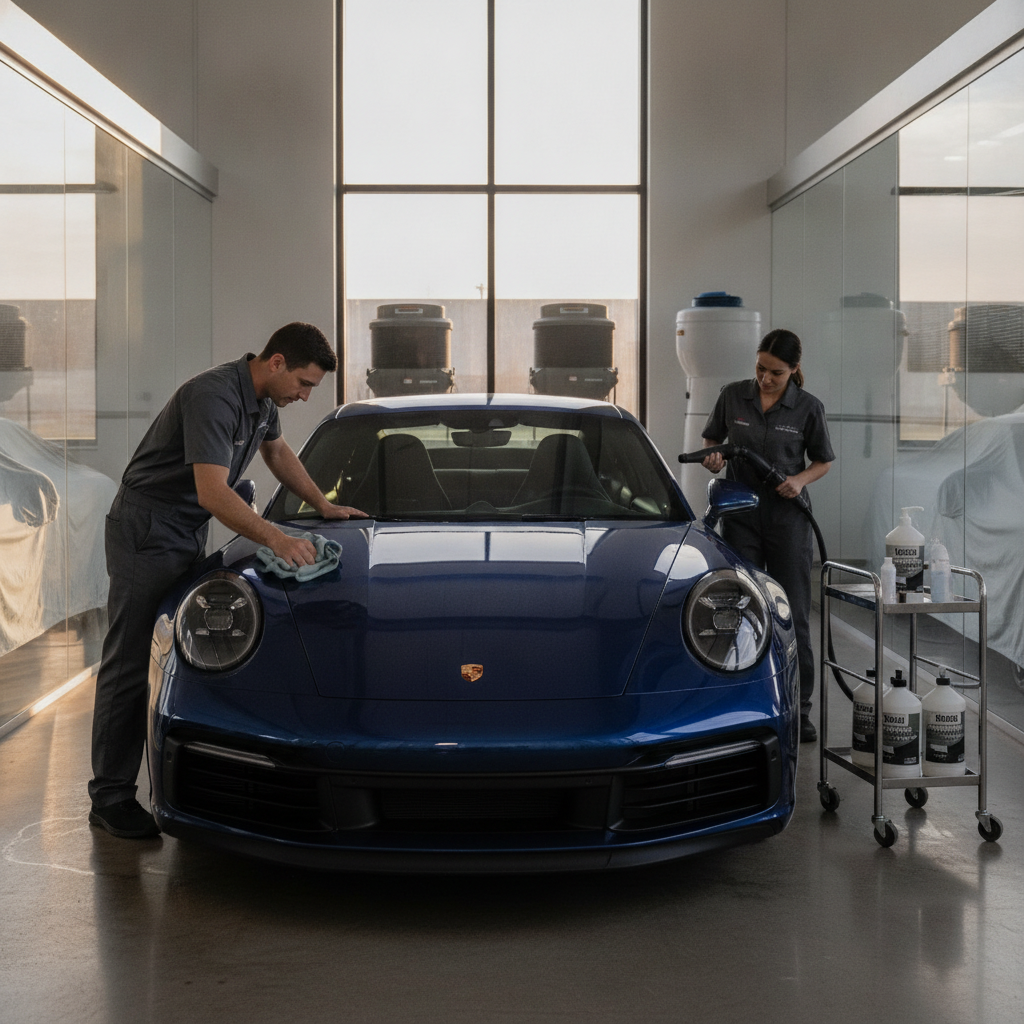
How Do You Maintain a Ceramic Coating After It’s Applied — And What Bloomfield Hills and Birmingham Owners Usually Get Wrong
Yes, ceramic coating dramatically reduces how much effort your paint requires day-to-day — but it does not eliminate the need for care. If you’ve just had a coating applied, or you’re considering one, the most important thing to understand is this: the coating’s lifespan is largely determined by what you do after it cures, not just the quality of the product or the installer’s prep work. Owners across Bloomfield Hills, Birmingham, and the broader Oakland County area often invest $600 to $2,000 or more in a quality ceramic coating, then unknowingly undermine it within the first season. Here’s what proper post-coating maintenance actually looks like — and where most people go wrong.
The Curing Window: What No One Tells You About the First 30 Days
Most professional-grade ceramic coatings require a full cure period before they reach their rated hardness and hydrophobic performance — typically 24 to 72 hours before any water contact, and a full 14 to 30 days before the coating is fully cross-linked at the molecular level. During that window, the coating is more vulnerable than it will ever be again.
What that means practically: no automatic car washes, no rain exposure if you can help it, no bird droppings left to sit, and no washing with anything other than a pH-neutral soap applied by hand. This window also isn’t the time to park under a tree or leave the vehicle outside through a Michigan freeze-thaw cycle. The coating needs stable conditions to cure correctly.
This is a detail that’s rarely explained in depth at the point of sale — and it’s one of the most common reasons a coating that should last four or five years starts showing hydrophobic degradation after one Michigan winter.
Why Automatic Car Washes Are the Fastest Way to Degrade a Ceramic Coating
This one is straightforward but underappreciated: automatic tunnel washes — including the touchless ones — are incompatible with long-term coating health. Tunnel washes that use brushes or foam curtains apply abrasive friction across your paint surface. Even soft-touch systems introduce microcontact that gradually erodes the coating’s surface layer and leaves behind light marring that dulls the gloss over time.
Touchless washes avoid that problem but introduce another one: they compensate for zero mechanical agitation by using highly alkaline or acidic chemical solutions that strip contaminants aggressively. Those same chemicals attack the hydrophobic layer of a ceramic coating. Run your coated car through a touchless wash repeatedly throughout a Michigan winter, and you’re chemically stripping the protection you paid for.
The correct approach is a two-bucket hand wash with a pH-neutral automotive shampoo, a quality microfiber wash mitt, and proper drying technique. This isn’t just enthusiasm — it’s how you protect the investment. For owners who genuinely don’t have the time or setup to do this correctly at home, scheduling a maintenance wash with a professional detailer a few times per year is entirely reasonable and far less expensive than a re-coating.
SiO2 Booster Sprays: The Maintenance Step Most Owners Skip Entirely
One of the most underutilized tools in ceramic coating maintenance is a silicon dioxide (SiO2) booster spray — also called a coating refresher or topcoat spray. These products are formulated to bond to an existing ceramic coating and reinforce the hydrophobic layer that takes the most environmental abuse.
Think of it this way: your base coating handles the heavy lifting — chemical resistance, scratch resistance, UV blocking, and long-term bonding to the clear coat. The hydrophobic surface layer that causes water to bead and sheet is the part that gradually depletes with every wash, every road salt application, and every summer UV cycle. A quality SiO2 booster, applied every two to four months, replenishes that surface layer and effectively extends the rated lifespan of the underlying coating.
For owners in Northville, Plymouth, and the surrounding area who drive year-round through Michigan winters, this step is especially relevant. Road salt is particularly aggressive at breaking down surface hydrophobicity. If you’re noticing that water is no longer beading the way it did when your coating was fresh, that’s your signal — not that the coating has failed, but that the surface layer needs refreshing.
Annual Inspections Matter More Than Most Coating Shops Mention
A quality ceramic coating applied to a properly prepped surface should last anywhere from two to seven years depending on the product tier, application conditions, and how well it’s maintained. But “lasting” doesn’t mean performing at full capacity throughout that entire window without any attention.
An annual professional inspection — where a trained eye examines the coating under lighting conditions that reveal degradation, thin spots, or contamination buildup — lets you catch issues before they compromise the underlying clear coat. In some cases, a targeted decontamination and spot-repair of compromised zones is all that’s needed to restore full performance without a complete re-coating.
Most coating shops in the Metro Detroit area don’t offer or emphasize annual inspection services because there’s not much margin in it for them. That’s a gap worth knowing about. At Specialized Automotive, Nate built the business around the idea that the relationship with a vehicle doesn’t end when you leave the bay — it continues through every Michigan season that vehicle has to endure.
What Michigan’s Climate Does to a Ceramic Coating That Isn’t Maintained
Michigan’s four-season climate is genuinely demanding on paint protection systems. Road salt applied from November through March doesn’t just rinse off — it bonds to contamination and gets driven into surface texture. Summer UV intensity, especially during July and August, degrades surface chemistry faster than in more temperate climates. The freeze-thaw cycles in between stress any material that’s bonded to a painted surface.
A ceramic coating that’s properly maintained handles all of this well. One that isn’t gets overwhelmed season by season. By the time visible degradation appears — loss of gloss, water no longer beading properly, light contamination that won’t wash off — the surface layer has already been compromised for some time. At that point, you’re looking at a decontamination treatment, a possible light polish, and a re-application of booster or fresh coating. That’s not a crisis, but it’s avoidable with consistent care.
Frequently Asked Questions About Ceramic Coating Maintenance
How often should I wash a ceramic-coated car?
Every two to four weeks is a reasonable target for a daily driver, using a two-bucket method and pH-neutral shampoo. If you’re driving through Michigan winters regularly, more frequent maintenance washes may be warranted to remove salt buildup before it has time to work against the coating.
Can I use any car soap on a ceramic-coated vehicle?
No. Many traditional car soaps contain wax or conditioning agents that are designed to add a layer on top of the paint — those will fill in the coating’s surface texture and reduce its hydrophobic performance. Use a pH-neutral shampoo specifically labeled as coating-safe.
Will bird droppings or tree sap damage my ceramic coating?
Yes — not immediately, but if left to sit. Both are acidic and will etch into the coating’s surface over time, especially in summer heat. Remove them as quickly as possible with a coating-safe detailing spray and a clean microfiber cloth. The coating provides a buffer, but it’s not a permanent shield against prolonged chemical contact.
How do I know when my ceramic coating needs to be refreshed or re-applied?
The clearest sign is water behavior. If water no longer sheets cleanly off the surface and instead clings or forms irregular beads, the hydrophobic layer has depleted. A SiO2 booster may restore it. If the issue persists after boosting, or if the coating is approaching the end of its rated lifespan, it’s time for a professional evaluation.
Does Specialized Automotive offer ceramic coating maintenance services for vehicles coated elsewhere?
Yes. Whether the coating was applied by us or another shop in the Novi, Bloomfield Hills, or Birmingham area, we can evaluate the coating’s current condition, perform a decontamination treatment, and recommend the appropriate next step — whether that’s a booster application, spot correction, or a full re-coat.
Protect What You Invested In
A ceramic coating is one of the most effective long-term paint protection decisions you can make for a vehicle in Michigan — but only if it’s maintained properly. The coating itself does the hard work. Your job is not to undermine it with the wrong products, the wrong wash methods, or neglect during the season it’s working hardest.
If you’re in Livonia, Bloomfield Hills, Birmingham, or anywhere across Oakland County and you have questions about your coating’s current condition or what a proper maintenance routine looks like for your specific vehicle, reach out to Specialized Automotive. Appointments are available seven days a week, and we’re happy to walk through what your coating needs based on its age, product type, and how it’s been treated since application. No pressure — just straight answers from someone who takes this as seriously as you do.