
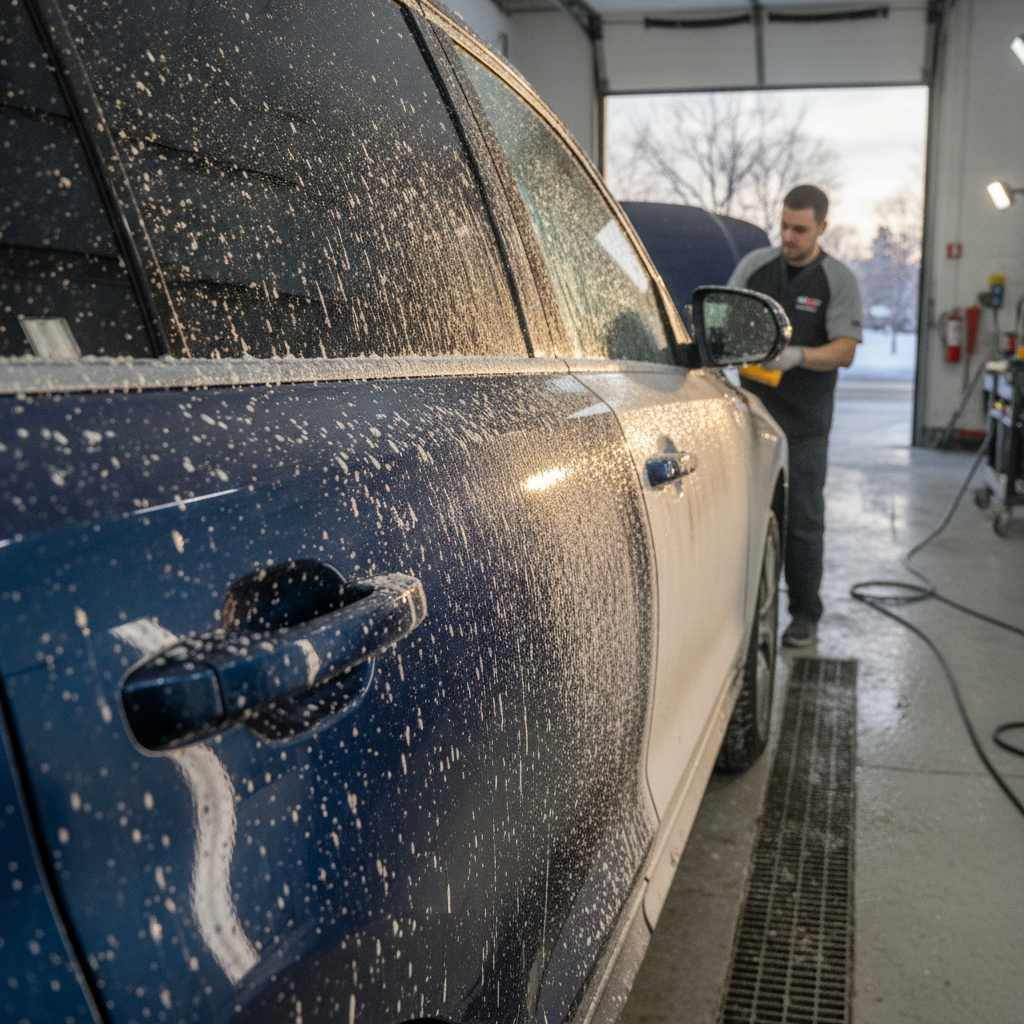
How Does Ceramic Coating Hold Up Against Michigan Road Salt? What Northville and Farmington Hills Drivers Need to Know
Yes — a properly applied professional ceramic coating provides meaningful, real-world protection against Michigan road salt. But the answer deserves more than a one-liner, because most of the ceramic coating content you’ll find online was written for drivers in California or Texas. It says almost nothing about what happens when your vehicle spends four months commuting through salted roads in Northville, Farmington Hills, or anywhere else in Metro Detroit. That gap is exactly what this article addresses.
What Road Salt Actually Does to Your Paint
Road salt — and the brine solutions MDOT uses on Michigan highways like I-275 and M-14 — isn’t just dirty. It’s chemically aggressive. Sodium chloride and calcium chloride break down in moisture and work their way into micro-scratches, chips, and porous clear coat surfaces. Left in contact with bare or inadequately protected paint, salt accelerates oxidation, dulls finish, and over time contributes to the kind of chalky, degraded clear coat you see on high-mileage Michigan vehicles that never got proper protection.
The freeze-thaw cycle compounds the problem. Salt brine gets into tiny surface imperfections, freezes, expands, and works deeper into the paint structure. By the time you notice dullness or fading, the damage is already done at a microscopic level. This is why paint correction is often the first conversation we have with customers who have driven unprotected through a few Michigan winters.
How Ceramic Coating Creates a Chemical Barrier Against Salt
A professional-grade ceramic coating — not a spray-on consumer product from a shelf, but an installer-applied SiO2 or SiC formulation — bonds to the clear coat at a molecular level and creates a semi-permanent hydrophobic surface. What that means in practical terms for a Michigan driver:
- Salt brine beads off rather than sitting on the surface. Water and the contaminants it carries — including road salt — don’t bond to a properly coated surface the way they do to bare or waxed paint.
- The coating resists chemical etching. Calcium chloride brine is corrosive. Ceramic coatings have significantly higher chemical resistance than wax or paint sealants, which is directly relevant to the brine-heavy products Michigan roads use in winter.
- Cleaning becomes faster and more complete. When salt and grime don’t bond deeply to the surface, a thorough wash after a winter commute actually removes the contaminants instead of just smearing them around.
- The clear coat underneath stays intact longer. You’re not just protecting the look of the paint — you’re protecting the structural integrity of the clear coat that guards the color layer beneath it.
This is a meaningful, real-world benefit for anyone driving daily in Wayne County or Oakland County from November through March. Wax degrades in weeks under Michigan winter conditions. A quality ceramic coating, applied correctly, holds up for years.
What Competitors Aren’t Telling You: The Prep Work Is Everything
Here’s the gap you won’t find addressed on most local competitor sites: how the paint is prepared before coating is the single biggest factor in how well the ceramic coating performs against road salt. A coating applied over contaminated, swirl-marked, or oxidized paint is not doing the job it’s capable of doing. The bonding is compromised, and so is the protection.
At Specialized Automotive in Livonia, every ceramic coating starts with a proper paint decontamination and, where needed, professional paint correction before a single drop of coating goes on. That step-by-step approach — decontaminate, correct, coat — is what separates a coating that performs in real Michigan conditions from one that looks great in photos for six months and then starts failing.
If you’re in Northville or Farmington Hills and you’ve been quoted a ceramic coating with no mention of prep work or paint correction, ask exactly what the process includes before you commit. A legitimate installer will walk you through every step.
Single-Layer vs. Multi-Layer Coating: Does It Matter for Salt Resistance?
Yes, and it’s worth understanding before you book. A single-layer coating provides a solid baseline of protection and is a worthwhile investment for most daily drivers in the Metro Detroit area. Multi-layer coatings — two or more layers of coating product applied and cured in stages — build greater film thickness and durability, which translates to stronger chemical resistance and a longer service life under harsh Michigan conditions.
For a daily driver that commutes through Farmington Hills winters every year, a well-applied single-layer coating is a significant upgrade over bare paint or traditional wax. For a higher-value vehicle, a collector car you drive occasionally, or an exotic you want protected for the long term, a multi-layer application makes more sense. Pricing generally runs from around $600 for a single-layer entry-level application on a standard vehicle, up to $1,500 or more for multi-layer protection on larger or more complex vehicles — with thorough prep included at every level. You can review Wayne County service and pricing details for a clearer picture of what to expect.
Does Ceramic Coating Protect the Undercarriage Too?
This question comes up often from Plymouth and Canton drivers who’ve dealt with undercarriage rust issues — and it’s a fair one. Standard ceramic coating is applied to painted exterior surfaces, not raw metal undercarriage components. For undercarriage protection against road salt, you’re looking at undercoating or rustproofing treatments, which are a different category of service. What a quality full-detail paired with ceramic coating does accomplish is thorough salt removal from every exterior surface before winter salt compounds the damage further. A professional seasonal detail that includes undercarriage flushing is often the right first step before any coating application.
Timing: When Should You Get Coated for Best Salt Protection?
Late summer through early fall — August through October — is the ideal window for Michigan drivers. That gives the coating time to fully cure before road salt season starts. If you missed that window and you’re heading into winter unprotected, a thorough decontamination detail is the right move now, with coating planned for spring. A coating applied in November on a properly prepped vehicle is still dramatically better than driving through another Michigan winter on bare paint.
Spring is also a critical time to assess your paint. After a full winter of road salt exposure, a professional ceramic coating consultation will help you understand what your paint actually needs — whether that’s a fresh coating on a well-maintained surface or a more involved correction-and-coat process.
Frequently Asked Questions
Does ceramic coating prevent rust?
Ceramic coating protects painted surfaces from the chemical damage that can lead to clear coat breakdown and eventual rust in areas where chips or scratches are exposed. It’s not a substitute for undercoating or rustproofing on raw metal. Think of it as your paint’s primary defense — it keeps the surface intact so minor chips and scratches don’t become pathways for salt to reach bare metal.
How long does ceramic coating last on a vehicle driven through Michigan winters?
A professionally applied coating, properly maintained, typically lasts two to five years on a daily driver in Michigan conditions. Regular washing — especially after heavy salt exposure — is important for maintaining the coating’s performance. Annual inspections and occasional maintenance treatments can extend the life of the coating further.
Can I get ceramic coating applied in winter?
Yes, with the right shop setup. Ceramic coating requires controlled temperature and humidity during application and cure time — conditions we maintain at our Livonia facility year-round. You don’t need to wait until spring.
Do I still need to wash my car regularly if it’s ceramic coated?
Absolutely. A ceramic coating makes washing more effective and less frequent, but it doesn’t eliminate the need to remove road salt after winter driving. Letting salt sit on a coated surface for weeks at a time will eventually degrade the coating’s performance. Regular washing is still part of protecting your investment.
Is a ceramic coating worth it for a daily driver, not just a collector car?
Especially for a daily driver in Michigan. Collector cars often spend winters in storage and avoid salt exposure altogether. Your daily driver gets hit with road salt every single day from November through March. That’s exactly the vehicle that benefits most from a durable chemical barrier between the paint and Michigan roads.
Get the Right Protection Before the Next Michigan Winter
If your vehicle is currently unprotected or you’re not confident in the condition of your paint heading into another Michigan winter, this is the right time to have a professional look at it. Specialized Automotive serves Northville, Farmington Hills, Novi, Plymouth, Canton, and the broader Wayne and Oakland County area from our Livonia location near the I-275 and M-14 interchange — easy in, easy out, and available seven days a week.
Reach out through our contact page to schedule a consultation or ask about our ceramic coating packages. We’ll assess your paint honestly, walk you through what it actually needs, and give you a clear picture of your options — no pressure, no upselling on work that isn’t warranted.