
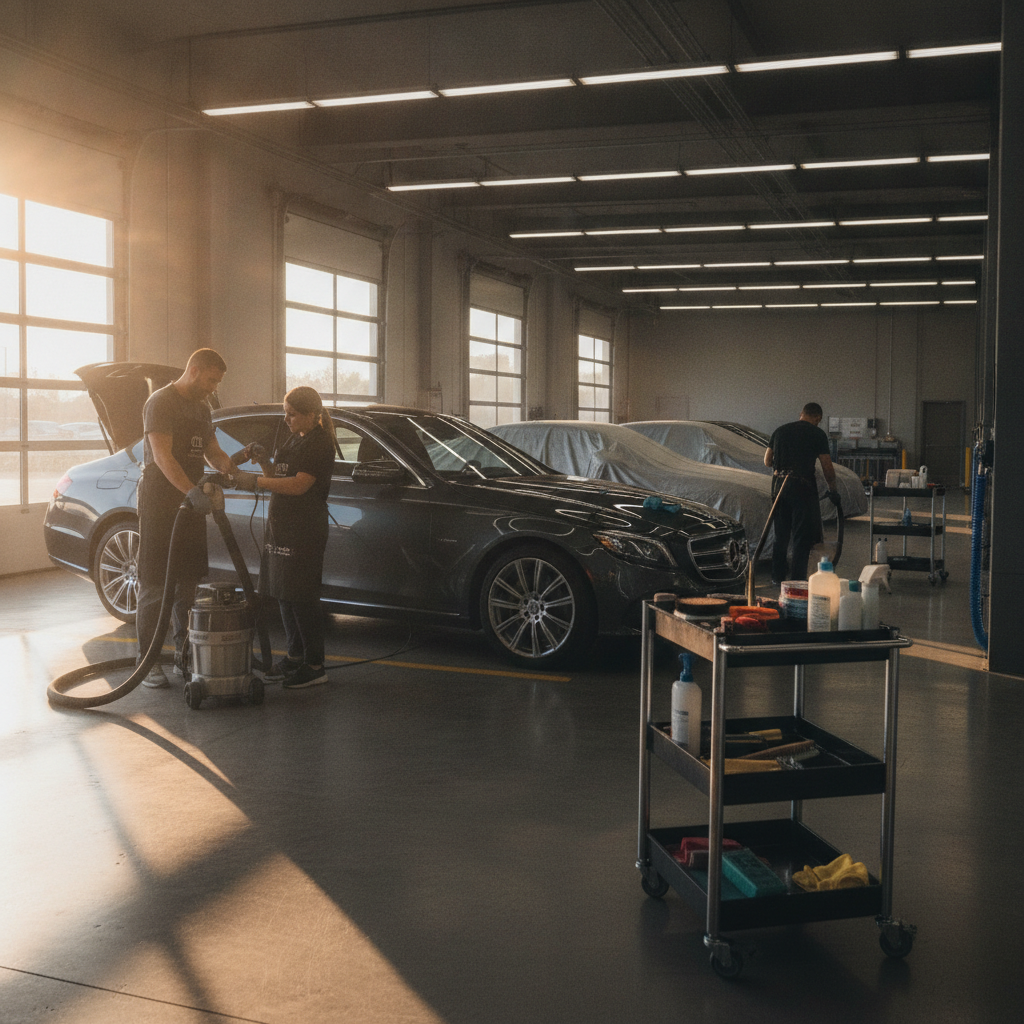
How Do You Detail the Interior of a Car the Right Way — And What Are Livonia Owners Actually Paying For?
A professional interior detail in Livonia is not a vacuum and a can of Armor All. Done correctly, it’s a multi-hour, methodical process that covers every surface inside your vehicle — from the headliner down to the carpet pile — using professional-grade equipment and materials that you simply cannot replicate with what’s under your kitchen sink. If you’ve ever wondered why an interior detail costs what it does, or whether you’re actually getting what you paid for, this is the honest breakdown you’ve been looking for.
Why Interior Detailing Gets Undersold and Misunderstood
The exterior gets most of the attention in detailing marketing — paint correction, ceramic coatings, gloss levels. That’s fair; it’s the part people see at 20 feet. But for the people who actually live in their vehicles, the interior is where the experience is. It’s also where Michigan’s four-season climate does its quietest damage. Salt and slush tracked in on boots all winter. Summer humidity baking into cloth seats. Coffee, dog hair, kid stuff, gym bags. By the time spring rolls around, most interiors in the Metro Detroit area have taken a beating that a gas station vacuum station won’t fix.
Most local competitor sites we’ve seen either list interior detailing as a bullet point on a menu page or describe it in vague terms like “full interior cleaning.” What they rarely explain is what that actually involves — which makes it nearly impossible for you to evaluate whether you’re getting a real service or a rush job. That gap matters, because the difference between a competent interior detail and a lazy one is significant, and it shows up in ways that last.
What a Proper Interior Detail Actually Covers
There’s a logical order to interior detailing, and skipping steps or doing them out of sequence produces worse results. Here’s how a thorough interior detail should unfold:
Dry Extraction and Pre-Vacuuming
Before any product touches anything, loose debris needs to come out — all of it. That means pulling floor mats, moving seats forward and back to reach under them, vacuuming the seat track channels, extracting from the door pockets and center console, and getting into the trunk or cargo area. A high-powered commercial vacuum does this step in a way that a shop-vac or household unit simply can’t match. Any professional skipping this step or rushing through it is setting up every step after it to be less effective.
Surface-Specific Cleaning for Every Material Type
This is where the real work is, and it’s why interior detailing takes time. Different surfaces inside your vehicle require different products and different techniques:
- Hard plastics and trim panels: Cleaned with a dedicated interior cleaner, using brushes of different sizes to reach vents, seams, and texture grooves. The goal is clean and natural-looking — not greasy, not shiny-for-the-sake-of-shiny.
- Cloth and fabric seats: Steam cleaned or treated with an upholstery cleaner and agitated with a brush, then extracted. Staining, odor absorption, and embedded grime all require dwell time and mechanical agitation, not just a wipe.
- Leather seats and trim: Cleaned with a pH-balanced leather cleaner, conditioned with a quality leather conditioner to restore suppleness and prevent cracking. Michigan summers bake leather interiors. Michigan winters dry them out. Skipping conditioning means the leather is technically clean but still deteriorating.
- Carpets and floor mats: Shampooed, agitated, and extracted. Salt residue from a Michigan winter leaves a white, crystalline film deep in carpet fibers that vacuuming alone won’t remove — it has to be dissolved and pulled out.
- Glass surfaces: Interior glass is often overlooked or done last with the same product used on the dash, which leaves haze. Proper interior glass cleaning uses a dedicated glass cleaner and a clean microfiber to eliminate film from off-gassing plastics and interior fumes.
- Headliner: Spot-treated with care — the headliner fabric is typically glued, and over-saturating it can cause delamination. A detail tech who doesn’t know this will damage a headliner trying to clean it aggressively.
Odor Elimination — Not Just Masking
Odor is one of the most common reasons people book an interior detail, and it’s one of the most commonly handled poorly. Spraying an air freshener at the end isn’t odor elimination — it’s concealment that lasts about a week. Genuine odor removal requires treating the source: steam, enzymatic cleaners on organic odor sources (pets, food, mildew), and in some cases ozone treatment for smoke or severe contamination. If a detailer doesn’t ask about odor when you book, that’s a signal worth noting.
What Interior Detailing Costs — And What Affects the Price
Pricing for interior detailing in Livonia and the surrounding Wayne County area varies based on vehicle size, condition, and scope of work. A single-occupant daily driver in decent condition will cost less than a three-row SUV with dog hair embedded in every seam, salt-caked carpets, and a coffee stain that’s been there since February. Honest detailers will ask about the vehicle’s condition before quoting — anyone who gives you a firm price over the phone without asking about condition either hasn’t thought it through or is going to cut corners to hit that number.
For context: a thorough interior-only detail on a typical sedan or small SUV in fair condition runs in the range of a few hours of labor with professional products. Larger vehicles, worse conditions, added services like leather conditioning or ozone treatment, and pre-detail inspections all affect the final scope. See our Wayne County detailing breakdown for a more specific look at how we approach pricing across vehicle types.
The Michigan Factor: Why Local Interiors Take More Punishment
Vehicles in Plymouth, Canton, Westland, Dearborn, and Redford all share the same seasonal reality: six months of boots tracking in road salt, sand, and slush, followed by a summer that bakes everything that survived the winter. That combination creates interior conditions that are genuinely harder to address than what a detailer in a milder climate deals with. Salt in carpet fibers is corrosive and attracts moisture, which leads to mildew and odor. UV through windows fades dash surfaces and dries leather faster than most people expect. A real interior detail addresses the Michigan-specific damage — it doesn’t just freshen up an already-clean cabin.
What This Looks Like at Specialized Automotive
At Specialized Automotive, every interior detail follows the same systematic approach whether the vehicle is a daily-driver Silverado from Redford or a collector car coming out of long-term storage. Nate built this business on the standard he developed detailing and preparing high-value classic and performance vehicles — and that standard doesn’t get adjusted based on how pedestrian the car looks. Every vehicle gets the same methodical process, the same material-specific products, and the same inspection before it leaves.
We’re located off the I-275 / M-14 and I-96 corridor in Livonia, which puts us within easy reach for owners across Wayne County and into Oakland County. We’re open seven days a week and every vehicle we touch is covered under our satisfaction guarantee.
Frequently Asked Questions: Interior Detailing in Livonia and Wayne County
How long does a professional interior detail take?
For a typical passenger car or smaller SUV in average condition, expect two to four hours. Larger vehicles, heavily soiled interiors, or add-ons like leather conditioning and ozone treatment extend that. Anyone promising a complete interior detail in under an hour is either skipping steps or doing surface-level work.
Does interior detailing remove pet hair?
Yes — but it’s one of the more labor-intensive parts of the job. Pet hair embeds in fabric and carpet in ways that a standard vacuum won’t fully address. Professional detailers use rubber tools, compressed air, and extraction equipment to pull it out. Heavily pet-impacted vehicles may warrant a surcharge; a good shop will flag this upfront.
What’s the difference between interior detailing and a basic car wash interior clean?
A car wash interior clean is typically a vacuum, a wipe of the dash, and maybe a window pass — done in 10 minutes. An interior detail is a multi-hour, surface-specific process using professional products and equipment. The results look different, feel different, and last significantly longer.
Can interior detailing actually remove smoke smell?
Standard cleaning alone usually won’t fully eliminate smoke odor because the smell penetrates into porous surfaces — headliner, carpet backing, seat foam, HVAC vents. Ozone treatment is the most effective approach for severe smoke contamination, and it requires the vehicle to sit in a sealed space during treatment. Ask your detailer specifically whether ozone is included or available before booking.
How often should I have my interior professionally detailed?
For most daily drivers in the Metro Detroit area, once or twice a year is a reasonable baseline — a thorough spring detail after winter salt season, and again in the fall before the next one starts. High-use vehicles, families with kids or pets, or anyone who eats in their car regularly will benefit from more frequent attention. Collector and exotic vehicles that come out of storage are also strong candidates for an interior pass before they go back on the road.
Ready to Book Your Interior Detail in Livonia?
If you want to know exactly what’s involved before you book — what products we use, how long it’ll take for your specific vehicle, and what to expect from start to finish — we’re easy to reach. Contact Specialized Automotive to get a straight answer and schedule a time that works for you. No pressure, no upselling, no vague quotes. Just a real conversation about what your vehicle actually needs.