
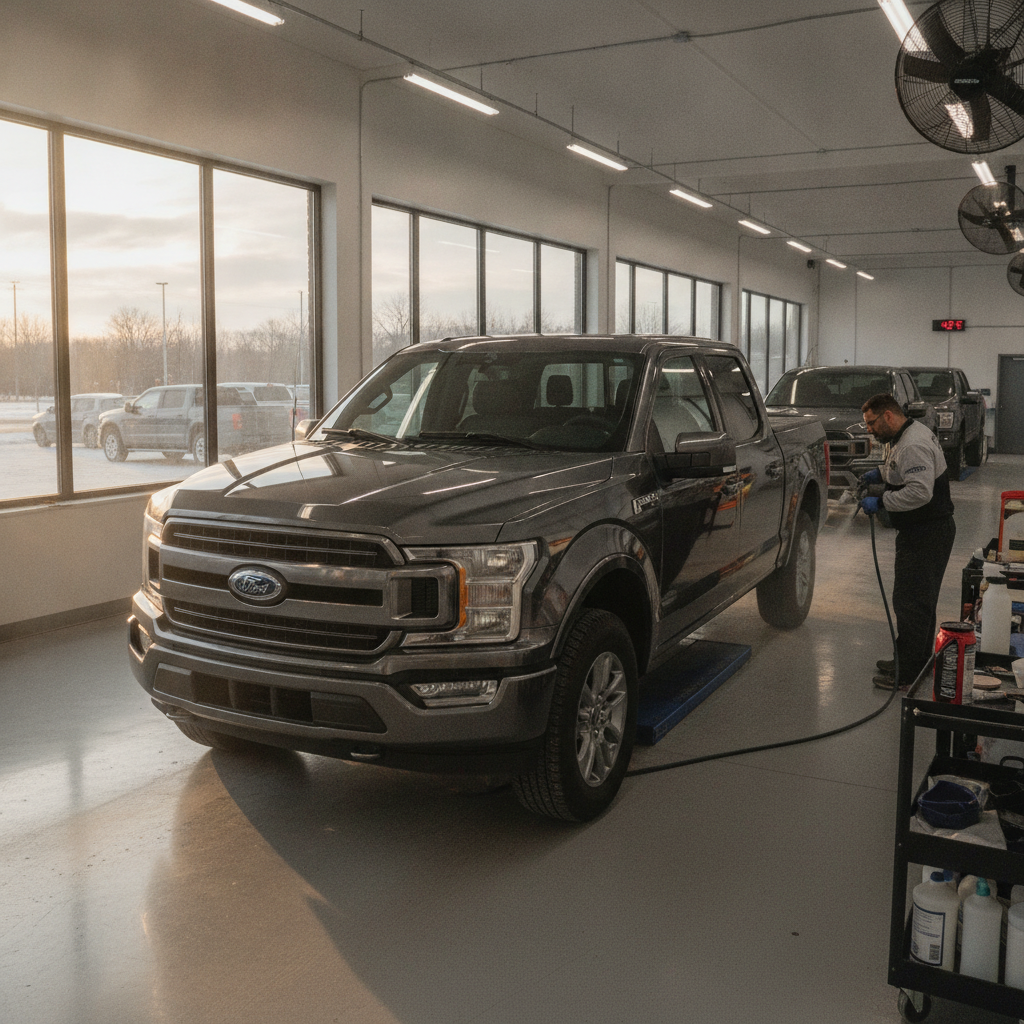
If you just picked up a new truck in Canton, Wayne, or anywhere in the western Wayne County corridor, here’s something the dealer probably didn’t mention: that factory paint is not ready for a Michigan winter. The clear coat is thin, the undercarriage has minimal protection beyond a factory undercoat, and the moment road salt starts flying off I-275 and M-14 in November, your brand-new truck starts taking damage. The good news is that a proper pre-winter detail and protection treatment — done right before the salt season hits — can stop that damage before it starts. Here’s what that actually looks like, and why the timing matters more than most truck owners realize.
Why a Brand-New Truck Still Needs Professional Protection Before Winter
It’s an easy assumption to make: the truck is new, the paint is perfect, and it’s got a warranty. You’ll figure out protection later. But “later” in Michigan often means after three months of salt exposure, freeze-thaw cycles, and road grime that’s already worked its way into every panel gap and seam. New doesn’t mean protected — it just means the damage hasn’t started yet.
Factory clear coats are applied in controlled environments and optimized for cost efficiency, not long-term durability against Michigan’s specific road conditions. Southwest Wayne County — Canton, Wayne, Westland, and the surrounding area — sits right in the path of I-94, I-275, and M-14 interchange traffic. If you’re driving those roads regularly from November through March, your truck is getting hammered with brine, road salt, and gravel-spray every single week. Without a proper protection layer, that punishment goes straight to bare clear coat.
What a Pre-Winter Truck Detail Actually Involves
A proper pre-season detail for a truck isn’t just a wash and wipe-down. Here’s what the process actually looks like when it’s done correctly:
- Full exterior decontamination: Even a new truck from the lot has transport film residue, rail dust, and industrial fallout embedded in the paint. This gets removed chemically and mechanically before anything protective goes on top.
- Paint inspection and light correction: New vehicles often come off the lot with light swirl marks from dealer prep washes or transport contact. A quick inspection catches these before they’re sealed under a coating.
- Undercarriage cleaning and inspection: The undercarriage is where Michigan winters do their worst work. Getting it properly cleaned and inspected before the salt season gives you a baseline — and a much better surface for any protective treatment.
- Interior protection: Floor mats, carpet, and seats take a beating from wet, salty boots all winter. Proper interior treatment before the season is far easier than cleaning dried salt damage in March.
- Ceramic coating or paint sealant application: This is the step that actually matters for long-term protection — and where the decision you make now will define how your truck looks in three years.
Ceramic Coating a New Truck: Is It Worth Doing Before Winter?
Yes — and if you’re going to do it, doing it before winter is the right call. A professionally applied ceramic coating bonds to the clear coat and creates a chemically resistant, hydrophobic barrier that sheds road salt, brine, and contamination rather than letting it sit on the paint. That protection is exactly what you want heading into a Michigan winter, not something you apply in the spring after the damage is already done.
For trucks, ceramic coating is especially practical. You’re dealing with a larger surface area, more exposure to road debris from riding higher off the ground, and in many cases a bed and tailgate that take additional wear. A quality multi-layer ceramic coating protects all of it — and unlike wax, it doesn’t wash off after a few winter washes. It lasts years, not weeks.
One thing to understand going in: ceramic coating requires the surface to be properly prepped first. If the paint has any contamination, minor swirls, or defects, those get corrected or treated before the coating goes down. The coating doesn’t hide imperfections — it locks in whatever the paint looks like underneath. That’s why the prep work isn’t optional, it’s the whole point.
What About the Dealer’s Paint Protection Package?
Most Canton and Wayne truck buyers are offered some version of paint protection at the dealership — it gets bundled into the financing, the paperwork moves fast, and it sounds reasonable. What you’re usually getting is a mid-tier sealant product applied by detailers working under volume pressure, with minimal prep and no real accountability for results. It’s not ceramic coating, regardless of what the paperwork says, and it’s not going to hold up the way a professionally applied coating does.
If you already accepted a dealer package, that doesn’t necessarily mean you’re stuck — but it does mean a professional assessment of what’s actually on the paint is worthwhile before adding any additional layers. Not every product plays well with every other product, and knowing what you’re working with matters.
The Undercarriage Problem Nobody Talks About — But Should
Here’s the angle that most detailing content in Metro Detroit skips entirely: the undercarriage of your truck is the most vulnerable surface on the vehicle, and it’s almost never addressed adequately. Road salt doesn’t just affect your paint — it attacks exposed metal, brake lines, suspension components, and frame seams that are sitting directly above the road surface all winter long.
For truck owners in Wayne County, undercarriage cleaning before and after winter isn’t optional maintenance — it’s the difference between a truck that looks good at ten years and one that’s showing serious corrosion by year five. A professional truck detailing service that includes a real undercarriage flush and inspection gives you both peace of mind and a clean baseline heading into the season. If anything concerning turns up underneath, you want to know before the truck’s been sitting in salt for three months.
Timing: When Should You Book Before Salt Season?
In the Livonia and Canton area, road departments typically start pre-treating with brine in October and salt application is heavy by mid-November. That means your window for pre-season protection — before your truck sees a single salted road — is September and early October. Waiting until November means you’re already behind.
If you’ve just taken delivery of a new truck or you’re coming into fall with a truck that’s never been properly protected, now is the right time to schedule. Appointments at Specialized Automotive are available seven days a week, and we’re located right off the I-275 / M-14 interchange in Livonia — easy access whether you’re coming from Canton, Plymouth, Westland, or further out.
Frequently Asked Questions
Does a new truck’s factory paint need any prep before ceramic coating?
Yes. Factory paint typically has transport residue, industrial fallout, and sometimes light swirl marks from dealer prep. The surface needs to be fully decontaminated — and any defects corrected — before a coating is applied. Skipping prep and applying coating over contamination locks that contamination in permanently.
How long does ceramic coating take on a full-size truck?
A full pre-winter detail and ceramic coating on a full-size truck typically takes one to two days depending on the condition of the paint and the number of coating layers. We’ll give you a realistic timeline estimate when you bring it in.
Is ceramic coating on a truck worth it if I use it for work?
Especially if you use it for work. A working truck sees more contamination, road debris, and grime than almost any other vehicle. Ceramic coating makes weekly maintenance significantly easier and provides actual protection against the surface damage that comes with daily work use. It’s not just for show trucks.
What’s the difference between an automatic car wash and a professional truck detail for winter prep?
An automatic car wash removes loose surface dirt. It doesn’t remove embedded road contaminants, doesn’t touch the undercarriage thoroughly, doesn’t address interior salt buildup, and applies nothing protective to the paint. Pre-season truck detailing is a fundamentally different service with a different purpose.
Can I get my truck detailed and ceramic coated in the same appointment?
Yes — and that’s actually how it’s designed to work. The detail and decontamination process is the necessary prep step before coating application. We handle the full process start to finish so there’s no coordination gap between services.
Get Your Truck Ready Before Road Salt Season
A new truck is a serious investment, and protecting it properly before the worst months of the year is one of the smartest things you can do with it. Specialized Automotive handles the full process — decontamination, paint correction when needed, undercarriage cleaning, interior protection, and professional ceramic coating — with the same precision we bring to classic and exotic vehicles. Every truck gets treated like it matters, because it does.
If you’re in Canton, Wayne, Westland, Plymouth, or anywhere in the western Wayne County area, we’re close, we’re insured, and we’re available seven days a week. Reach out to schedule your pre-winter truck detail and coating consultation — before the salt trucks start running.