
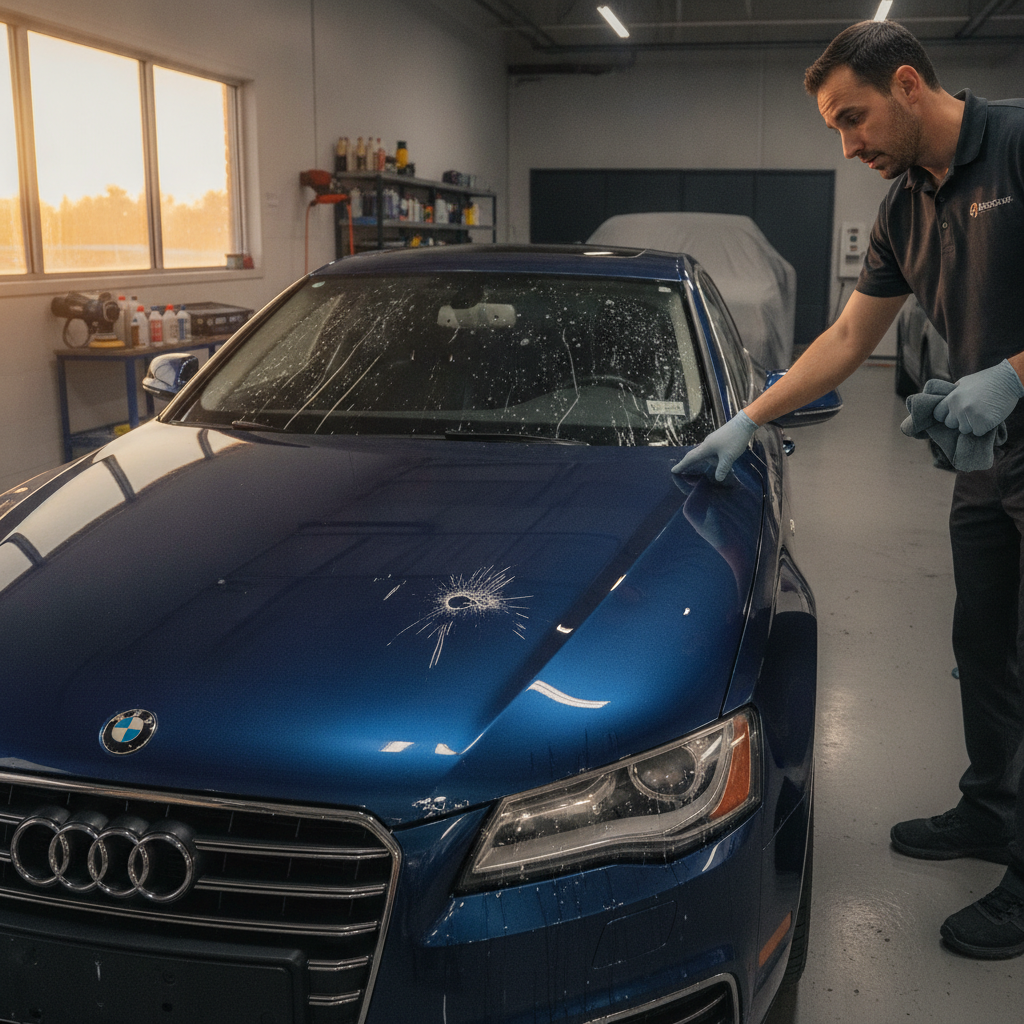
Can You Fix Paint Chips and Scratches Before Ceramic Coating — And What Southfield and Detroit Owners Need to Know First
Yes — and if you care about the result, you have to. Ceramic coating is a semi-permanent layer that bonds directly to your paint surface. Whatever imperfections are sitting on that surface when the coating goes down — paint chips, deep scratches, rust-prone bare metal spots — are going to be magnified and locked in, not hidden. If you’re driving around Southfield, commuting into Detroit, or putting miles on a vehicle anywhere in Wayne County, your paint is dealing with real road hazards every single day. Understanding what needs to happen before a ceramic coating is applied could be the difference between a result you’re proud of and one you’re stuck with.
Why Paint Chips Are a Bigger Problem Than They Look
A small paint chip on a door edge or hood doesn’t seem urgent. It’s easy to rationalize: the car still looks fine from ten feet away, and you’re planning to get it coated anyway, so why not just get it done? Here’s the problem — ceramic coating is transparent. It seals in texture, color inconsistencies, and surface defects with a layer of exceptional hardness. Once it cures, you’re not peeling it back and starting over without significant professional work.
More critically, a bare metal chip that goes unaddressed before coating is still exposed to moisture. Michigan’s freeze-thaw cycles are brutal on unprotected metal. Road salt migrates into chips, water follows, and oxidation begins below the surface. A ceramic coating applied over that chip doesn’t stop the corrosion underneath — it just hides it until the rust blooms through. That’s not a protection story. That’s an expensive mistake.
What Should Actually Happen Before the Coating Goes On
This is where most coating conversations get glossed over, and frankly, it’s the part that separates a shop that knows what it’s doing from one that’s rushing to put coating on a car and collect a check. Here’s the honest sequence:
- Thorough decontamination wash: Road grime, iron fallout from brake dust, embedded tar, and road salt residue all have to come off completely. Any contamination left on the surface will be bonded under the coating.
- Paint chip evaluation: Not every chip requires the same fix. A chip that’s still in the clear coat layer versus one that’s penetrated to bare metal are two entirely different situations. A qualified detailer assesses each chip before recommending a course of action.
- Chip touch-up or repair: Bare metal chips, especially on hoods, bumpers, and leading edges where stone strikes concentrate, should be touched up with factory-matched paint before coating. This won’t make a chip invisible, but it will seal the metal and create a stable, protected surface for the coating to bond to.
- Paint correction: This is the step that directly addresses scratches, swirl marks, and surface marring. A professional paint correction uses machine polishing to remove or minimize these imperfections from the clear coat before the ceramic layer goes down. It’s not optional if you want the coating to look the way it should.
- Panel wipe and IPA prep: After correction, every panel gets wiped down with an isopropyl alcohol solution to strip any remaining polish oils. Ceramic coating requires a completely clean, oil-free surface to bond correctly.
The Gap Most Local Shops Don’t Talk About: Deep Scratches That Can’t Be Polished Out
Here’s a topic that doesn’t get nearly enough honest airtime in the Metro Detroit detailing market. Paint correction handles clear coat scratches and marring — the kind that catch light and create swirl patterns. But a scratch that has broken through the clear coat and into the color coat, or worse, reached the primer or bare metal, cannot be corrected with a polishing machine. Polishing a scratch that deep would only remove more clear coat without fixing the scratch itself.
For those scratches, the honest answer is that touch-up paint, wet sanding, or in severe cases a panel respray is the right solution before coating. A shop that coats over deep scratches without disclosing this to you isn’t doing you a favor — they’re locking in the damage and calling it done. At Specialized Automotive, the evaluation step exists precisely for this reason. Nate built the business around doing this work the way it should be done, which means telling you what your paint actually needs before any coating conversation happens.
What This Means for Daily Drivers and High-Mileage Vehicles
You don’t have to own a rare collector car or an exotic to benefit from doing this correctly. Daily drivers — especially those commuting on I-96, dealing with construction debris near the Southfield Freeway, or parking in surface lots around Dearborn — accumulate real paint damage over time. If you’re planning to keep your vehicle for another five or more years, addressing chips and scratches before a ceramic coating is one of the most cost-effective investments you can make in its long-term condition and resale value.
The same logic applies in reverse: if your paint is severely damaged, a coating consultation will tell you whether correction is a practical first step or whether you’d be better served by other bodywork before pursuing a coating at all. That kind of honest conversation is worth more than a shop that just takes your money and schedules the appointment.
For vehicles with paint that’s in reasonable condition, ceramic coating after proper prep delivers real, lasting results — protection against UV fading during Farmington Hills summers, resistance to road salt and chemical contamination through Michigan winters, and a surface that stays cleaner between washes for years.
What to Ask Before You Commit to Any Coating Shop
- Do you inspect and document paint chip and scratch conditions before the job starts?
- Is paint correction included, or is it a separate step you recommend based on the vehicle’s condition?
- How do you handle bare-metal chips — do you touch them up, or coat over them?
- Can I see the paint condition before and after correction, before the coating goes down?
- What’s your process if a scratch is deeper than the clear coat?
Any shop that can’t answer these questions clearly hasn’t earned your trust yet.
Frequently Asked Questions
Will ceramic coating hide paint chips and scratches?
No. Ceramic coating is transparent and follows the surface exactly. It will actually make chips and scratches more visible under certain lighting by adding gloss around them. They need to be addressed before the coating is applied.
Do I need full paint correction before every ceramic coating?
Not necessarily — but the paint needs to be evaluated first. If your paint has significant swirl marks, scratches, or marring, correction before coating is strongly recommended. If the paint is in genuinely good condition, a thorough decontamination and prep may be sufficient. The right answer depends on what’s actually on your vehicle.
Can touch-up paint make a chip invisible before coating?
Touch-up paint seals the chip and protects bare metal — it won’t make the chip disappear or match perfectly. For chips in highly visible areas, wet sanding and blending after the touch-up can minimize the appearance. Realistic expectations matter here.
How long does paint correction take before a ceramic coating appointment?
It depends on the vehicle’s condition and size. A one-stage correction on a smaller vehicle might take a full day. A multi-stage correction on a larger or more heavily marred vehicle can take two or more days. This is why same-day or next-day coating appointments at budget shops often skip this step entirely.
Does Specialized Automotive serve the Southfield and Detroit area?
Yes. Specialized Automotive is located off the I-275 / M-14 and I-96 corridor in Livonia, making it an easy drive for owners coming in from Southfield, Dearborn, Detroit, and surrounding Wayne County communities. Appointments are available seven days a week.
Ready to Get an Honest Assessment Before You Commit to a Coating?
If you’ve been thinking about ceramic coating but aren’t sure what your paint actually needs first, the right move is a real evaluation — not a sales pitch. At Specialized Automotive, every coating consultation starts with an honest look at your paint’s current condition, what prep it actually requires, and what the job should cost before anything gets scheduled. No guesswork, no surprises locked under a semi-permanent coating.
Contact Specialized Automotive to schedule your paint evaluation and ceramic coating consultation. We’re open seven days a week and serve vehicle owners across Livonia, Southfield, Detroit, Dearborn, Farmington Hills, and the broader Metro Detroit area.