
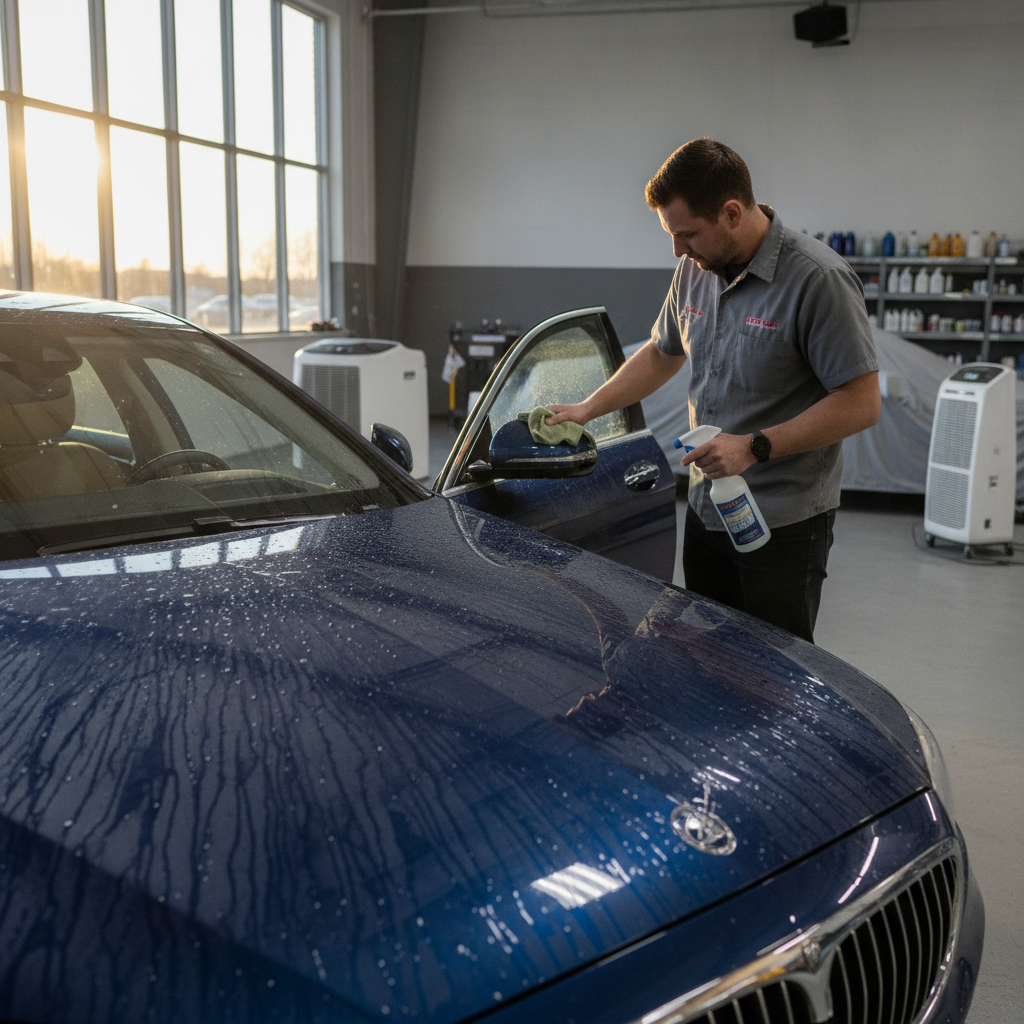
How Do You Get Water Spots, Mineral Deposits, and Hard Water Stains Off a Car’s Paint in Southfield or Redford Without Scratching It?
Yes, water spots can be removed — but the right approach depends entirely on how deep they’ve bonded to your paint, and getting it wrong can leave you with scratches that are harder to fix than the spots themselves. For vehicle owners in Southfield, Redford, Livonia, and across Wayne and Oakland County, water spotting is a genuinely common problem that rarely gets a straight answer. Most detailing content online either brushes past it or points you toward a bottle of vinegar and calls it done. That’s not good enough when you’re dealing with mineral deposits that have etched into your clear coat.
What Are Water Spots Actually Doing to Your Paint?
Water spots aren’t just a cosmetic annoyance. When water evaporates off the surface of your paint — whether from rain, a sprinkler, a garden hose rinse, or even a poorly rinsed car wash — it leaves behind dissolved minerals: calcium, magnesium, silica, and other compounds picked up along the way. In Michigan, where municipal water sources across Wayne County and Oakland County carry measurable mineral content, this happens faster than most owners expect.
There are three distinct stages of water spot damage, and they don’t all respond to the same treatment:
- Stage 1 — Surface deposits: Minerals sitting on top of the clear coat. These haven’t bonded yet and can usually be dissolved with a proper pH-balanced water spot remover or a diluted white vinegar solution applied carefully and rinsed immediately. This stage is forgiving if you act fast.
- Stage 2 — Bonded mineral deposits: The minerals have dried and adhered to the clear coat surface. You can feel a slight texture. At this stage, chemical removers alone often won’t cut it — you need mechanical intervention, meaning light machine polishing.
- Stage 3 — Etched clear coat: The mineral content has chemically reacted with the clear coat itself, creating a physical depression or ring in the paint. This is true etching, and it requires paint correction — machine polishing with a cutting compound — to level the surrounding clear coat and eliminate the mark. No spray bottle is fixing this.
The frustrating part? Most vehicle owners don’t catch water spots until they’ve already progressed to Stage 2 or 3. By then, the DIY options that show up in a quick Google search — vinegar, dish soap, over-the-counter spray detailers — aren’t going to get you where you need to be.
Why This Problem Is Worse in Metro Detroit Than You Might Think
Michigan’s climate creates a perfect storm for water spot damage that owners in warmer, drier states don’t deal with at the same scale. Southfield and Redford both sit in areas where vehicles see the full range of seasonal abuse: road salt and brine spray through a long winter, spring rain that’s often mineral-heavy, summer heat that bakes any water residue onto the paint within minutes of exposure, and humid conditions that keep paint surfaces wet and vulnerable longer.
If you’re parking outside — even in a driveway — you’re dealing with irrigation runoff, acid rain residue, and municipal water from any hose rinse. Vehicles that sit near sprinkler systems, or that get rinsed at automatic car washes that don’t use a spot-free final rinse, accumulate mineral deposits faster than most owners realize. By the time the spots are visible, they’ve often already bonded.
This is one of the reasons professional detailing at the right intervals matters more in Michigan than in a lot of other markets — not just to clean the vehicle, but to catch and address surface contamination before it does lasting damage.
What Actually Works — And What Doesn’t
Stage 1: Chemical Removal
For fresh, surface-level deposits, a dedicated automotive water spot remover (not household cleaners, not undiluted vinegar) applied to a cool surface in a shaded area, allowed to dwell briefly, and rinsed clean can dissolve the minerals without mechanical abrasion. The key details that most online guides miss: never apply to a hot panel, never let the remover dry on the surface, and never use a dry cloth to wipe — always rinse first, then dry with a clean microfiber. Done wrong, even a Stage 1 removal can induce light scratches.
Stage 2 and 3: Machine Polishing and Paint Correction
Once minerals have bonded or etched, you’re looking at machine polishing. A dual-action or rotary polisher with an appropriate compound will remove enough clear coat to level the damaged area and restore optical clarity. This is where professional experience matters. Removing too much clear coat chasing a deep etch creates a new problem — thin paint that’s vulnerable to future damage. A qualified technician knows when to stop, how to test paint thickness, and when a spot is beyond what polishing alone can correct.
At Specialized Automotive in Livonia, paint correction work on water-spotted vehicles follows the same standard we apply to collector cars: read the paint before you touch it, use the least aggressive approach that actually works, and document what you find. Owners in Farmington Hills, Southfield, and across the I-275 corridor bring us vehicles with varying degrees of water spot etching regularly — it’s one of the most underestimated forms of paint damage in the area.
The Gap Most Local Detailing Content Ignores: Prevention After Removal
Here’s what almost no local competitor content addresses after covering water spot removal: what do you do to prevent it from happening again at the same rate? Removing the spots is only half the answer.
Once your paint surface has been corrected and is clean, applying a protective layer changes the equation significantly. On a bare clear coat, mineral deposits bond directly to the paint chemistry. On a hydrophobic-treated surface — whether that’s a paint sealant or a professional ceramic coating — water beads and sheets off instead of sitting and evaporating, and any minerals that do remain are bonding to the coating rather than the clear coat itself. When properly maintained, a coated surface is dramatically easier to decontaminate and far less likely to develop true etched spots from normal exposure.
This is exactly why paint correction followed by ceramic coating is such a logical sequence for vehicles in Wayne County and Oakland County that spend time outside. You correct what’s there, protect the surface going forward, and the day-to-day exposure to Michigan’s mineral-heavy water and weather stops being a constant paint damage cycle.
Frequently Asked Questions
Can I use white vinegar to remove water spots from my car in Redford or Southfield?
For very fresh, light surface deposits, diluted white vinegar can dissolve mineral residue — but it must be used carefully on a cool surface, rinsed off immediately, and followed by a thorough wash. It is not a solution for bonded or etched water spots, and it should never be left on paint. When in doubt, a dedicated automotive water spot remover is safer.
How do I know if my water spots are etched into the clear coat or just sitting on top?
Run a clean, dry finger across the spot. If you feel a raised texture or ridge, the minerals are still sitting on the surface. If the area feels smooth but you see a ring or haze in the paint, the clear coat has been etched — the mineral has already reacted with the paint chemistry. Etching requires machine polishing to correct.
Will a regular car wash remove water spot deposits?
No. Standard car wash soap and rinse cycles are not formulated to dissolve calcium or silica-based mineral deposits. They may remove loose dirt around the spots, but the deposits themselves will remain — and may become more visible after the wash because the surrounding surface is clean.
Is ceramic coating worth it specifically for water spot prevention in Michigan?
For vehicles that park outside regularly in Metro Detroit, yes. The hydrophobic surface of a quality ceramic coating dramatically reduces the dwell time of water on paint, which is the primary driver of mineral deposit bonding. It won’t make your car immune to water spots, but it significantly slows the rate at which deposits form and makes routine decontamination much easier.
How much does professional water spot and mineral deposit removal cost near Livonia?
It depends on how far the damage has progressed. Surface decontamination as part of a full detail is generally included in the service. Bonded deposits requiring light machine polishing are typically addressed as part of a paint correction service. For accurate pricing based on your specific vehicle and damage level, the best step is a direct consultation — reach out to Specialized Automotive here.
Get Your Paint Assessed by Someone Who Actually Knows What to Look For
Water spot damage is one of those things that looks minor until it isn’t. If your vehicle has visible spots or hazy areas on the paint that don’t wash off, the right move is to have the surface properly assessed before you reach for a polish or try any chemical removal at home. The difference between a Stage 2 deposit and a Stage 3 etch isn’t always obvious to the naked eye — and treating them the same way costs you either time or clear coat.
Specialized Automotive is located in Livonia near the I-275 / M-14 and I-96 interchange, and we’re available seven days a week for vehicle assessments, detailing, and paint correction work. Whether you’re coming from Southfield, Redford, Farmington Hills, or anywhere across Wayne or Oakland County, we’ll tell you exactly what your paint needs — and what it doesn’t. Contact us to schedule a consultation or drop-off assessment. No pressure, just an honest read on your vehicle’s condition.