
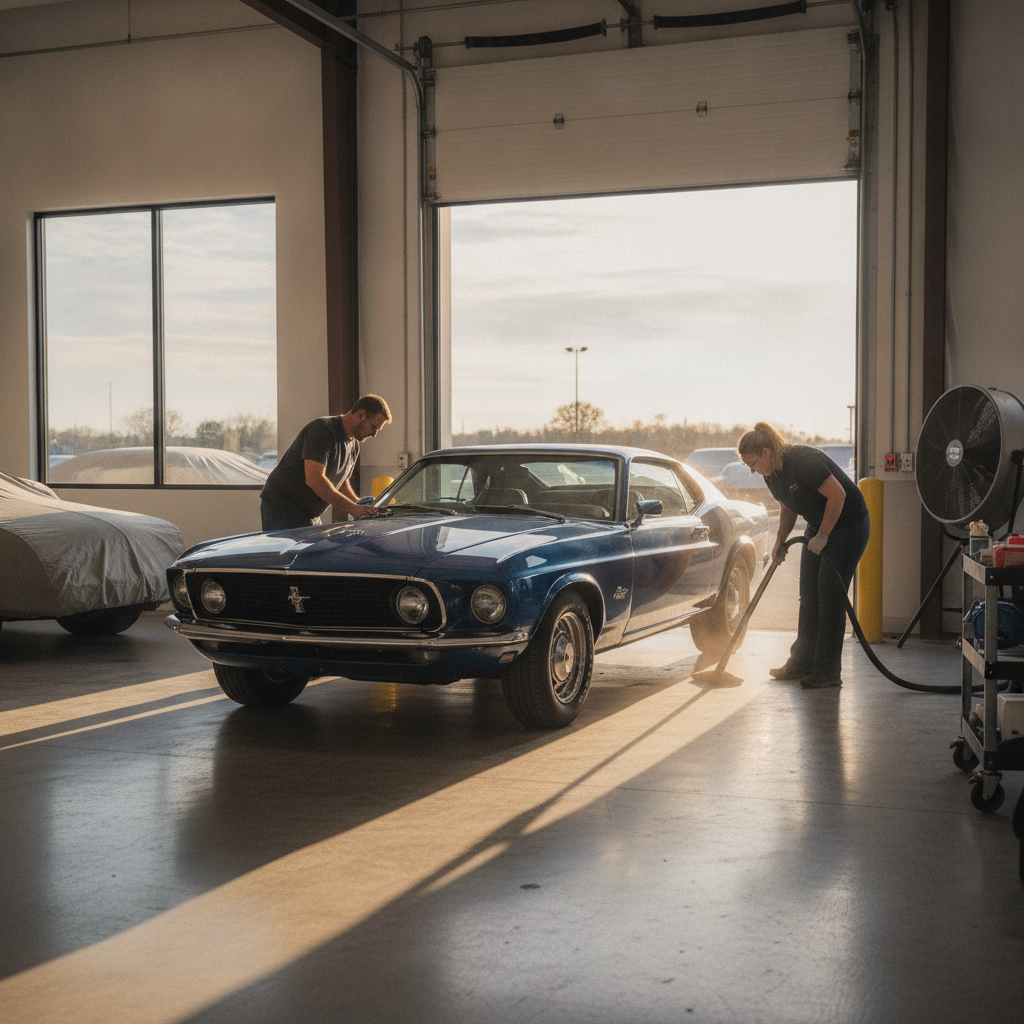
If you’re pulling a stored vehicle out for the first time after a Michigan winter — whether you’re in Dearborn, Taylor, or anywhere across Wayne County — the car isn’t ready to drive just because it starts. Months in storage, even in a good indoor facility, leave a vehicle in a specific condition that calls for a deliberate inspection and detailing process before you put real miles back on it. This is one of the most overlooked topics in the local detailing world, and it’s one that matters enormously for anyone who stores a collector car, a classic, or even a high-value daily driver off-season.
Why Post-Storage Detailing Is Different From a Regular Detail
A standard detail addresses what accumulates from regular driving — road film, water spots, interior debris. A post-storage detail is something else entirely. After three to five months sitting still, even in a clean, dry indoor environment, a vehicle develops its own set of surface conditions that don’t respond the same way to a routine wash-and-wipe approach.
Depending on the storage conditions, you may be dealing with:
- Surface oxidation or light etching from condensation that cycled through the facility during Michigan’s freeze-thaw months
- Dust bonded to any remaining wax or sealant that can scratch the paint if wiped dry
- Flat spots in tire pressure that need to be corrected before a wash (a minor mechanical note, but relevant before driving to a detailer)
- Interior off-gassing from materials that sat in low airflow for months — especially in leather and vinyl
- Rodent activity evidence — rare in quality facilities, but not unheard of in garage or barn storage situations common in Westland and Garden City residential neighborhoods
- Fuel and fluid concerns that may create light surface residue near seals or engine bay components
None of these conditions are catastrophic on their own — but treating them with the wrong products or technique, or skipping the inspection phase entirely, can make each one worse. That’s exactly where a professional post-storage detail earns its value.
The Right Order of Operations When a Stored Vehicle Comes Out
This is the part that most detailing content skips entirely — the sequence matters as much as the individual steps. At Specialized Automotive in Livonia, when a stored vehicle comes back out (whether from our own facility or somewhere else), we approach it with a specific inspection-first process rather than just loading it into a bay and starting the machine.
Step 1: Paint and Panel Inspection Before Any Water Touches the Car
The first thing that happens is a dry inspection under proper lighting. You’re looking for anything that changed during storage — a new scratch from a car cover shifting, a moisture-related water spot pattern, any bubbling under the clear coat that could indicate trapped moisture or early corrosion starting underneath. Vehicles stored near exterior walls in non-climate-controlled facilities are more vulnerable to this, especially in Wayne County where winter temperature swings are genuinely extreme.
If there’s anything that looks like it needs paint correction work — swirl marks from a car cover, light oxidation, water etching — that gets documented before anything else happens. You don’t want to wash a car, apply a new protection layer, and then discover a problem that requires correction. Correction before protection, always.
Step 2: A Proper Decontamination Wash — Not Just a Rinse
Even in clean storage, dust and airborne particles settle on paint over months. If there was any residual road grime from the fall that wasn’t washed off completely before storage, it’s now had a winter to bond more firmly to the surface. A proper decontamination wash — with a pH-neutral soap, iron decontamination spray, and clay bar treatment where needed — is the only way to actually start clean.
Skipping clay and going straight to a machine polisher on a contaminated surface is how you introduce new swirl marks. This is a mistake we see evidence of frequently on vehicles that come to us from owners in Taylor and Dearborn who attempted a post-storage cleanup themselves before realizing the result wasn’t what they expected.
Step 3: Interior Refresh and Ventilation
Interior materials that sit in low airflow for months need more than a vacuum. Leather that wasn’t properly conditioned before storage will be noticeably stiffer. Fabric seats may have light mildew odor even in otherwise clean conditions if there was any humidity exposure. Hard surfaces accumulate a fine dust film that smears if wiped with a damp cloth rather than properly lifted.
A thorough post-storage interior detail includes conditioning all leather and vinyl, treating any fabric with appropriate cleaners, and addressing the air quality inside the cabin — including the HVAC filter if the vehicle was stored with any moisture concern. For classic car owners in Dearborn and Southfield especially, many of whom are passionate about preserving original interior materials, this step deserves the same care as the exterior.
Step 4: Protection Layer Assessment or Application
Once the paint is clean and corrected if needed, the question becomes: what’s protecting it going forward? If the vehicle had a ceramic coating applied before storage, that coating should be inspected for coverage integrity and topped with an appropriate ceramic maintenance spray. If the protection layer was a wax or sealant, it’s likely degraded over the storage period and should be reapplied.
If you’ve been planning to upgrade to a proper ceramic coating — and a post-storage decontamination and correction is genuinely one of the best windows to do it — this is the moment. The paint is already being properly cleaned and corrected. Adding a ceramic layer at this stage means the vehicle comes out of its spring detail fully protected for the driving season rather than just temporarily polished.
What Happens When This Process Gets Skipped
The most common pattern we see is an owner pulling a vehicle out of storage, running it through a touchless car wash or even a hand wash at home, and putting it back into rotation. It looks reasonably clean. But the clay contamination is still on the paint, the interior leather hasn’t been conditioned, and any minor paint issues that developed during storage are now sealed under a layer of whatever quick detailer was applied at the wash.
By the time summer UV hits the paint in full force — and Michigan summers are genuinely harsh on unprotected finishes — those issues compound. What could have been addressed with a single post-storage detail session becomes a more involved paint correction project by August.
For vehicles stored over multiple winters, skipping proper post-storage care is cumulative. Each season leaves a layer of unaddressed damage that becomes progressively harder and more expensive to correct.
Bundled Storage and Detailing: What to Look For
One thing worth knowing if you’re evaluating storage options for next season: some facilities — including Specialized Automotive — build a complimentary detail into the storage package. That means when your vehicle comes out of indoor storage, the post-storage inspection and detail is already part of what you paid for. You’re not scheduling and paying for a second appointment on top of storage fees. For Wayne County owners managing multiple vehicles or a collector car alongside a daily driver, that bundled structure matters in terms of both logistics and cost.
When evaluating any local storage facility, ask directly whether a post-storage detail is included, what it covers, and who performs it. “We’ll wipe it down before you pick it up” is not a post-storage detail. A proper inspection, decontamination wash, interior refresh, and paint protection assessment is.
Frequently Asked Questions
How long does a post-storage detail typically take?
Depending on the vehicle’s condition and what correction work is needed, a thorough post-storage detail generally runs between three and eight hours. A clean, well-maintained classic in good storage condition is on the shorter end. A vehicle with paint correction needs, a heavily soiled interior, or a full ceramic coating application will require more time.
Can I just run a stored car through a car wash first?
A touchless rinse to remove loose surface dust before transporting it is fine. But an automated car wash — touchless or otherwise — doesn’t decontaminate paint, doesn’t condition interior materials, and can’t perform the inspection steps that matter most after winter storage. It’s not a substitute for a professional post-storage process.
My car was in a heated garage all winter. Does it still need a post-storage detail?
Yes. Heated residential garages in Taylor, Wayne, and Garden City still experience significant humidity fluctuation over a Michigan winter, and vehicle covers create their own micro-environment against the paint. A post-storage inspection and proper wash is appropriate regardless of storage conditions — it’s about addressing what actually happened to the vehicle, not assuming nothing did.
What if I notice a new scratch or paint issue when the car comes out of storage?
Document it before anything else — photos under direct light. This is especially important if the vehicle was stored at a commercial facility and you want to address any coverage or liability question. Then schedule a paint correction consultation before proceeding with any other detail steps. Correcting the issue before applying protection is always the right sequence.
Do you detail vehicles that weren’t stored at your facility?
Absolutely. A significant portion of post-storage details we perform in Livonia are for vehicles that were stored elsewhere — private garages, other facilities, covered parking. The vehicle’s storage history informs what we look for, but we work with all stored vehicles regardless of where they spent the winter.
Ready to Get Your Vehicle Road-Ready After Storage?
If you’ve got a car coming out of storage — or you’re already driving one that didn’t get properly detailed before it went back into rotation this spring — Specialized Automotive is available seven days a week. We’re located near the I-275 / M-14 and I-96 interchange in Livonia, which puts us within easy reach for owners across Dearborn, Taylor, Southfield, Westland, Wayne, and all of Wayne County. Every vehicle, whether it’s a collector car worth six figures or a daily driver that spent one winter off the road, gets the same thorough inspection-first approach.
Contact us through our contact page to schedule a post-storage detail or to ask about our bundled storage and detailing packages for the upcoming off-season. Nate and the team are happy to walk through what your specific vehicle needs before booking anything.